How Insurance Case Management Software Reduces Billing Write-Downs and Increases Realization Rates

Insurance defense firms are under pressure to meet carrier billing standards while managing large case volumes. Many lose revenue to write-downs, low realization rates, and compliance issues caused by manual processes. Litify’s insurance case management software helps reduce these risks by capturing time more accurately, enforcing billing rules, and connecting billing to case documentation. Built on Salesforce and aligned with enterprise security standards, Litify offers the structure and visibility defense firms need to improve billing and profitability.
Insurance defense law firms handle complex, high-volume litigation under constant scrutiny and with little financial wiggle room. Between billing audits, carrier guidelines, and mounting workloads, even well-run firms lose revenue when hours go untracked or unpaid.
Insurance case management platforms like Litify help firms close those gaps and capture time more accurately, enforce billing compliance, and reduce costly write-downs. Billing becomes more predictable, and financial performance improves when these workflows run through a single platform of action.
Read on for guidance on uncovering where billing breakdowns occur and how software can help prevent write-downs before they happen.
Why billing write-downs happen in insurance defense
Defense firms lose thousands of hours to billing write-downs each year. These write-downs are often tied to issues that start well before the invoice is submitted, such as:
- Manual timekeeping that leads to missing or vague entries
- Billing that doesn’t meet outside counsel guidelines (OCGs)
- Lack of documentation to support billable activity
- Delays in submission or invoice formatting errors
Without the right systems, these problems often go unnoticed until after billing. By then, it’s too late to correct the issue. Over time, recurring write-downs chip away at profitability and create friction with carriers, especially when the same billing issues happen again. If that pattern continues, it can put a firm’s panel position at risk.
This is where outside counsel management and billing oversight need to work together, not separately.
The impact of low realization rates on defense firms
The realization rate measures the percentage of your billed time that is actually paid. For insurance defense law firms, this is one of the clearest indicators of profitability.
Firms with low realization often face several deeper issues within their billing workflow.
Manual timekeeping and delayed submissions
When time isn’t captured in the moment, it’s often incomplete. Lawyers who rely on memory tend to miss details. Submissions take longer, and invoices pile up and delay collections, all while increasing the chances of rejection.
Missing insight into billable work
Carriers expect supporting records tied to every billed task. If the platform doesn’t track crucial details and the applicable task alongside time entries, you’re more likely to encounter disputes. Even accurate time entries can be denied if they lack the necessary context or additional information.
Budget overruns and carrier distrust
Exceeding a budget isn’t always the issue. The problem is when it happens without warning, because carriers need to be able to anticipate costs. Without real-time budget tracking, defense firms may only realize there’s a problem after trust has already eroded.
For firms looking to improve their matter management, fixing these issues starts with software that supports time tracking, billing, and budgeting in one place.
How insurance case management software solves these challenges
Modern insurance case management software is built to prevent errors rather than just track them. With the right system, firms will find it easier to collect what they’ve earned.
Litify’s platform supports defense teams with:
- Real-time timekeeping
- Built-in compliance checks
- Budget tracking and alerts
- Carrier-friendly reports and dashboards
Capture more billable time with automated timekeeping
Litify helps teams track billable activity in real time. Lawyers can automatically capture calls, emails, meetings, and other work without relying on memory. Each entry is tied to a matter and can be reviewed, adjusted, and submitted more quickly.
At McFarlane Law, this shift to automated capture led to faster billing cycles and a 10% improvement in collections.
Enforce compliance before billing
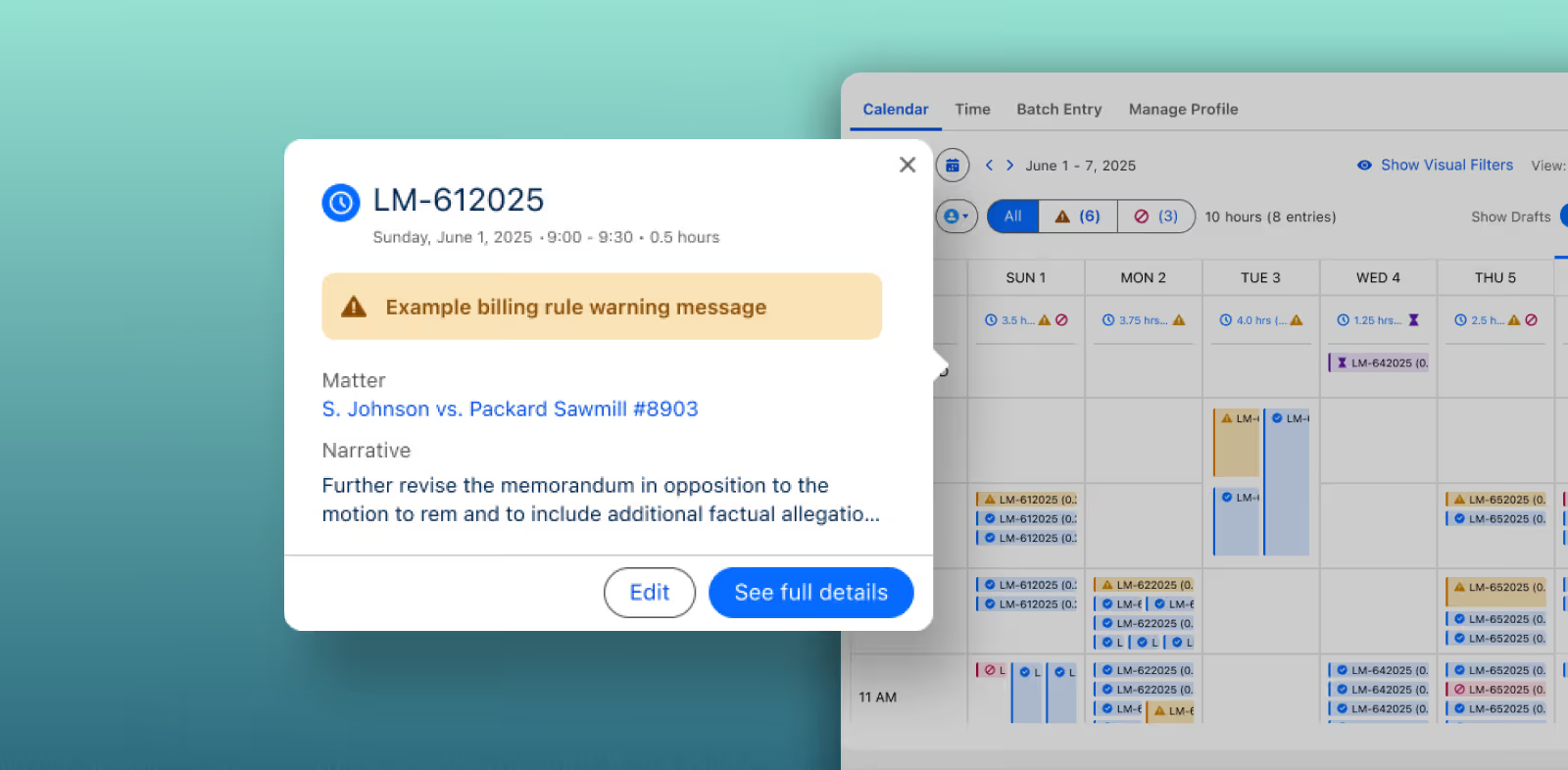
Carrier rules are enforced in real time. If an entry doesn’t match the required format or billing code, Litify flags it instantly. That prevents non-compliant hours from ever appearing on a final invoice.
Quintairos, Prieto, Wood & Boyer (QPWB) saw a measurable drop in write-downs after adopting real-time billing rule enforcement across 50+ offices. With nearly 1,000 users logging in weekly, the firm now catches issues before they escalate.
Budget and accrual tracking keep carriers aligned
Litify tracks matter budgets throughout the case lifecycle. If costs approach a threshold, alerts notify teams before a problem occurs. Firms can also share accruals and budget summaries in the exact formats carriers prefer. This improves transparency and helps avoid disputes later.
These insights are especially powerful when they’re tied to carrier outcomes. Staines, Eppling & Kenney now use Litify to track key metrics in real time, like case duration, settlement ranges, and billing performance, which has helped them justify rate increases.
With everything in one platform, the firm can share meaningful data with carriers and use that transparency to win new business.
Why security and compliance matter in defense billing
Carriers hold their panel firms to high standards, including how time is tracked, how data is stored, and how billing is submitted.
Modern insurance defense software features must support:
- Multi-factor authentication (MFA)
- SOC 2 Type II security compliance
- End-to-end encryption
- Audit trails for every time entry and invoice adjustment
Litify meets all of these standards and includes access controls that make it easy to limit data access by user, role, or firm. This kind of visibility builds trust and makes compliance part of everyday work without requiring manual management.
Choosing the right insurance case management software
Not all software is built for defense litigation. Many tools handle generic case management well but fall short in billing, budgeting, and carrier-specific workflows.
When evaluating tools, defense firms should look for:
- Workflows that reflect the way insurance litigation is handled (not adapted from other practice areas)
- Billing tools that enforce guidelines automatically
- Reports that help carriers track spend and outcomes
- Integrations with claims and eBilling systems already used by insurers
Litify’s insurance defense case management software meets all of these criteria. It’s built on Salesforce, configurable to each firm’s needs, and designed to help defense teams spend more time on legal work and less time chasing invoices.
It’s time to rethink how defense billing gets done
Write-downs and low realization rates are symptoms of systems that don’t support defense work.
Litify brings billing, timekeeping, and reporting into one connected platform. See how Litify helps insurance defense law firms build a more profitable and predictable billing process.
Frequently asked questions
Can insurance case management software reduce disputes with carriers?
Yes. Insurance case management software like Litify flags non-compliant entries at the point of entry, which prevents errors from ever reaching an invoice. It also ties time entries to the tasks themselves, so every billed task has a clear record of what was done, when, and by whom.
That level of detail reduces carrier pushback and makes the review process more predictable. Over time, firms can build stronger billing relationships by consistently meeting carrier expectations.
What kind of ROI can a defense firm expect from modernization?
Modern platforms like Litify help firms improve financial outcomes while saving time across the board. Benefits often include:
- Higher realization rates from accurate time capture and billing
- Fewer write-downs through real-time compliance checks
- Faster billing cycles via automated approvals and invoice generation
- Time savings from reduced manual review and corrections
Does insurance case management software integrate with the claims and billing systems that carriers use?
Yes, Litify integrates with leading eBilling platforms and claims systems used by insurance carriers. This includes the ability to format invoices, budget reports, and status updates to meet carrier expectations. Firms can maintain a more professional billing relationship while streamlining the information flow between both sides.
Is cloud-based case management secure enough for insurance litigation data?
Yes. Litify leverages the power of the Salesforce platform and meets strict enterprise-grade security standards, including SOC 2 Type II compliance. The platform includes encryption, role-based access, and multi-factor authentication (MFA) to keep sensitive legal and client data secure. All activity is logged for full auditability, which is especially important for regulated insurance workflows.