Next Best Action Automation: The Future of AI-Driven Workflows

For years, the promise of AI in legal operations has sounded something like this: imagine if your platform could tell you what to do next. Fewer missed deadlines. Fewer cases falling through the cracks. Less time on manual work and more time driving outcomes.
That promise is no longer hypothetical. Litify makes it possible with Litify ACE and our AI-native platform of action, which brings AI directly into the platform where your data lives, enabling it to spot patterns, surface signals in real time, and take action on your behalf.
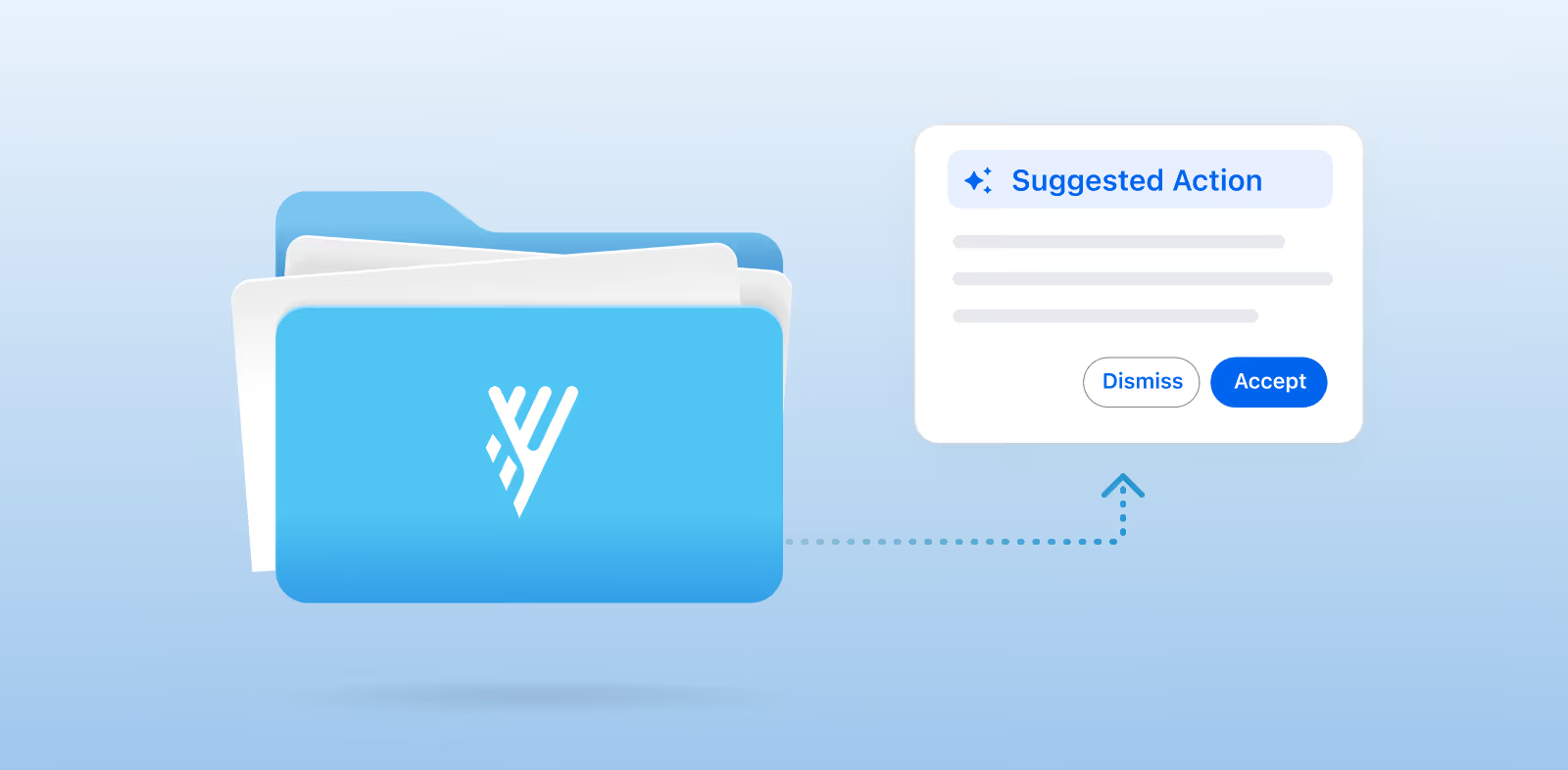
With AI so deeply embedded, legal professionals are actively building (and, in many cases, already running) intelligent next-best-action workflows in Litify. Next-best-action workflows are multi-step processes that progress automatically or with AI-powered recommendations, suggested natively within the platform.
Here's a look at how teams are approaching next-best-action automations today and where legal AI is headed.
Using native Litify data as decision points
Before investing in advanced AI workflows, the most impactful place to start is often the simplest: the data you're already capturing.
Every field logged in Litify is a potential decision point. The question is whether your platform is doing anything with that information or just storing it.
Consider a few real-world examples:
Negotiation triggers: When a matter accumulates three or more counteroffers without moving to the next step, that's a signal. Automated flows can detect this pattern and immediately draft a litigation review for the managing partner to review, without the prelit attorney having to think about it. The work happens in the background, triggered entirely by the data being entered.
Statute of limitations alerts: For firms practicing in states with bad-faith claim windows, a demand sent date is more than a timestamp — it's the start of a countdown. Automated reminders at the 25-day mark (before a 30-day deadline) ensure attorneys never miss the window to file, without requiring manual calendar management.
Budget setup: When an insurance carrier sends over their litigation budget sheet or requirements, the corresponding budget fields on the record are automatically populated, including coverage limits, phase budgets, task codes, and billing guidelines. When applicable, AI-driven actions can automatically result in an expense record for the firm to bill against.
Sentiment-driven intake intervention: Firms using AI-powered call coaching tools can push structured outputs, including call sentiment and next-step recommendations, into custom Litify objects. A negative sentiment score automatically triggers an alert to an intake supervisor, enabling early intervention before a potential client is lost.
Claim analysis: For in-house teams managing a heavy workload, AI can automatically compare claim data against historical outcomes to flag inconsistencies and mitigate risks that humans might otherwise miss during a manual review. If a discrepancy is flagged, AI can trigger an immediate notification to the team to investigate further.
Visual progress indicators: Sometimes the best next-action prompt isn't an email or a task — it's a color. Using custom visual components, teams can display green, yellow, and red indicators directly on the matter page based on SLA timelines, for example, giving staff an immediate, at-a-glance signal that something needs attention.
The common thread: none of these require rebuilding your workflows from scratch. They extend what you're already doing by using the data you're already collecting.
Turning unstructured documents into decision signals
If native data triggers represent the floor of next best action, unstructured document intelligence represents a major leap forward. For many businesses, it's where they are finding some of the most significant operational gains.
Medical records, memos, police reports, contracts, and bills are the lifeblood of case management. But for years, this information lived in PDFs and scanned documents that were nearly impossible to analyze at scale. Teams had to manage time-consuming manual data entry, which introduced too much inconsistency to support reliable automation.
The shift to structured data objects in Litify, such as normalizing treatment types, litigation budgets, injury categories, transcripts, insurance limits, and other claim data into queryable fields, was a critical first step. But the real change comes when AI tools can read unstructured documents and automatically generate clean, reliable outputs that feed back into those structured objects.
In practice, this looks like:
- A weekly digest report filtered by record type, delivered directly to case teams, replacing the manual file review that used to happen monthly
- Triggered alerts when high-value injury indicators are detected so attorneys can act within days rather than weeks
- Proactive identification of missing documents, such as a bill without a corresponding encounter or missing deposition files, so teams can request records before the gap becomes a litigation problem
How Litify ACE takes it to the next level
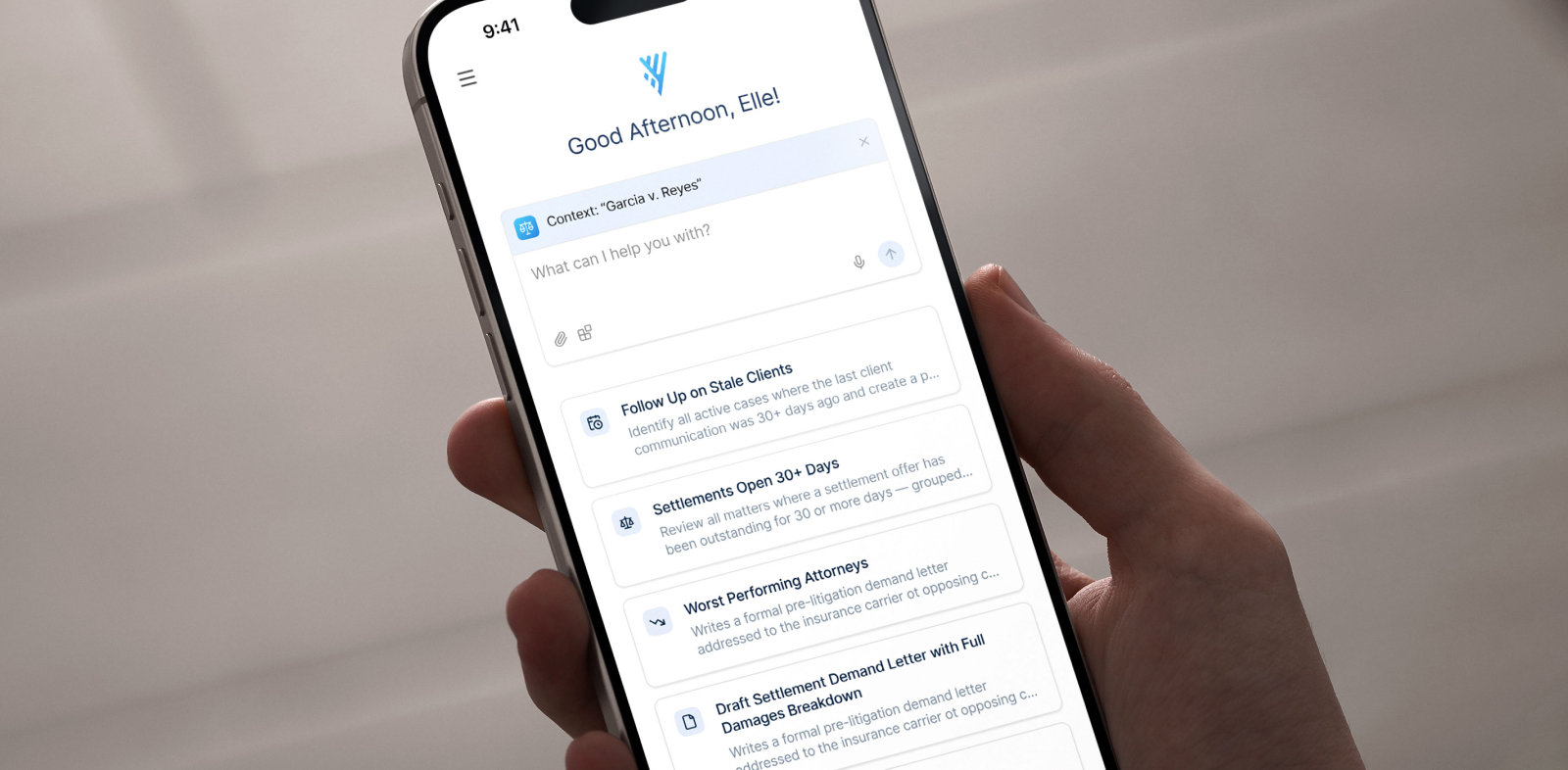
When AI acts as a proactive partner across your platform of action, your team never has to wonder what to work on next. Litify ACE moves far beyond passive chatbots that sit waiting for a prompt. It continuously analyzes your caseload, flags strategic risks, and surfaces role-aware recommendations the moment you log in.
Instead of staring at an empty prompt box or sorting through cluttered task queues, staff are greeted with proactive recommendations tuned directly to their active matters. ACE identifies optimal next steps with every interaction, guiding attorneys and legal ops professionals toward the highest-priority tasks to keep work moving forward.
These proactive capabilities keep your practice aligned around execution:
- Continuous case monitoring: Rather than waiting for a manual check, ACE constantly evaluates matter activity to flag emerging issues before they become delays, such as treatment gaps, stalled scheduling, or upcoming milestone deadlines.
- Contextual next steps: With every action taken, ACE intelligently predicts and recommends the logical follow-up, whether that means drafting a client update, requesting missing records, or alerting an attorney for review.
- Embedded best practices: Proactive recommendations naturally surface your firm’s standardized skills and playbooks in context, ensuring every staff member executes work aligned with your highest operational standard.
From proactive insight to automated execution.
Identifying the next best action is only half the equation. ACE’s multi-step agentic workflows actively help move work forward. Once a recommendation is surfaced or a workflow is triggered, ACE deploys role-specific agents to complete the heavy lifting autonomously while keeping your team in full control.
- Multi-step agentic workflows: ACE strings together the many steps a matter requires into a single continuous, automated workflow, executing actions on a single-matter or firm-wide scale.
- Ask & analyze: Instantly query across single matters or your entire firm. Identify conflicting deposition testimony, pinpoint causation gaps, compare policy limits against damages, or run plain-language queries across thousands of files to spot bottlenecks instantly.
- Draft & direct: Generate high-quality interrogatory responses, complex motions, legal memos, tailored cross-examination guides, and carrier-ready briefs in seconds, formatted directly to your firm’s style standards.
- Summarize & report: Turn complex transcripts, communications, and task histories into concise witness profiles or executive dashboards, complete with inline visual charts and one-click exports.
- Damages Assistant: Integrate medical chronology and bill reconciliation into Litify, running automatically whenever a medical record or bill is uploaded. It surfaces actionable signals and can trigger further workflows to address any issues.
- Instant Demands: Turn medical chronology and case data into a structured, configurable demand packet that is editable in real time and automatically filed to the matter upon completion.
In addition to pre-built agents, Litify ACE functions as a composable building block for automated flows across Salesforce, allowing law firms and legal departments to build custom agents tailored to their unique playbooks.
The underlying vision: AI that understands your matters, knows your business’s playbook, and proactively partners with your team to advance every case without waiting to be asked.
Where to start
For those who haven't yet built next-best-action workflows, the path forward doesn't require starting with the most sophisticated tools. The teams seeing the most success started with what they already had:
- Identifying the fields they were already logging and asking: What action should this trigger?
- Subscribing teams to targeted weekly reports rather than waiting for monthly file reviews
- Using visual indicators to surface priority cases without adding to email or task load
From there, the natural progression is toward richer data, smarter triggers, and eventually AI that closes the loop without requiring manual setup at every step.
The data is already there. The signals are already being generated. The question is whether your legal platform is acting on them or simply recording them.
Ready to get started? Schedule a demo of Litify ACE today to see next-best-action automation in Litify.