The Evolution of Legal Billing for Defense Law Firms

Modern law firm billing for insurance defense has evolved from rigid, manual systems into flexible, automated solutions. Early tools lacked adaptability; however, advancements such as LEDES standards and eBilling streamlined compliance and accuracy. Today’s legal time and billing software integrates automation, AI, and analytics to reduce errors, expedite payments, and ensure compliance with client guidelines. Platforms like Litify deliver real-time insights, multi-payer management, and predictive analytics, transforming legal billing from a manual chore into a strategic advantage for firms seeking efficiency, profitability, and compliance in a complex legal landscape.
In the early days of legal billing, law firms lacked a synchronized approach. Each component of their operations functioned independently, leading to disorganization.
Back then, legal time and billing software employed a rigid system that attempted to manage every case, client, and rate uniformly. This kind of approach created more complications than clarity for insurance defense law firms managing hundreds of cases.
Today, the recipe for success looks very different. As technology evolved, law firm billing automation brought flexibility, compliance, and accuracy to a process that once relied on manual tasks and workarounds.
Modern platforms like Litify's insurance defense software now combine automation, analytics, and AI to handle even the most complex defense billing needs, from LEDES billing software to alternative fee arrangements and multi-payer management.
The foundations of legal billing: Early tools and challenges
The first generation of law firm billing systems, developed in the 1980s and 1990s, was designed for a simpler era. Platforms like Barrister and Elite tracked hours and created invoices, but they couldn’t support the complexity that insurance defense work requires today.
Early systems only allowed hourly billing and couldn’t record historical data or adjust rates across timekeepers. Firms that needed to work with retainers, multiple payers, or non-hourly arrangements had to rely on manual edits or off-system tracking, which inevitably led to inconsistent reporting.
Those limitations were costly for high-volume defense practices. Staff would spend hours manually adjusting invoices, while attorneys lost billable time verifying compliance with client guidelines.
The rise of structured guidelines: LEDES, UTBMS, and mid-era advancements
The next major shift came with the introduction of LEDES billing software and LEDES codes in the late 1990s and early 2000s. These standards gave carriers and defense teams a reliable format for electronic billing (eBilling).
Paired with UTBMS task codes, firms could now classify every task and expense for easier review. Tools like Enterprise, Rainmaker, Aderant, and 3E built on this momentum by supporting group billing, global currencies, and flat-fee options.
Still, even these mid-era systems came with challenges. Implementations were long, reporting was limited, and teams often had to export data into spreadsheets to produce the insights leadership needed.
How hourly billing evolved to accommodate insurance audits
As insurance defense teams adopted eBilling, audits became stricter. Carriers began reviewing every time entry for accuracy and reasonableness. This forced firms to modernize their approach to time tracking and documentation for greater accuracy.
Block billing and vague task descriptions were common problems. Missing codes only made it worse. These errors often led to payment delays.
Firms needed a more effective way to validate entries before submission. Newer invoicing systems added built-in checks that made it easy to review bills before they were sent out.
Introducing alternative fee arrangements (AFAs) in insurance defense law firms
For decades, hourly billing dominated insurance defense, but carriers began seeking more predictable cost structures. This shift led to the rise of Alternative Fee Arrangements (AFAs), including retainers, flat fees, and blended rates.
AFAs create more predictable costs for carriers and more stable revenue for firms. They replace endless adjustments with clear, upfront agreements that strengthen trust on both sides.
Modern challenges in insurance defense law firm billing
Despite years of innovation, many defense teams still face the same core challenges:
- High case volume across multiple carriers and matter types
- Complex billing guidelines that vary by client
- Manual data entry that causes compliance errors
- Revenue leakage from missed or underbilled time
- Audit delays that extend payment cycles up to 90 days
These issues get worse when teams rely on legacy systems that can’t adapt to new carrier requirements. Firms need legal billing solutions that make it easier to stay compliant and ensure accurate invoices the first time. Luckily, many have already started turning things around with next-generation legal software.
Navigating strict insurer guidelines and audits for insurance defense law
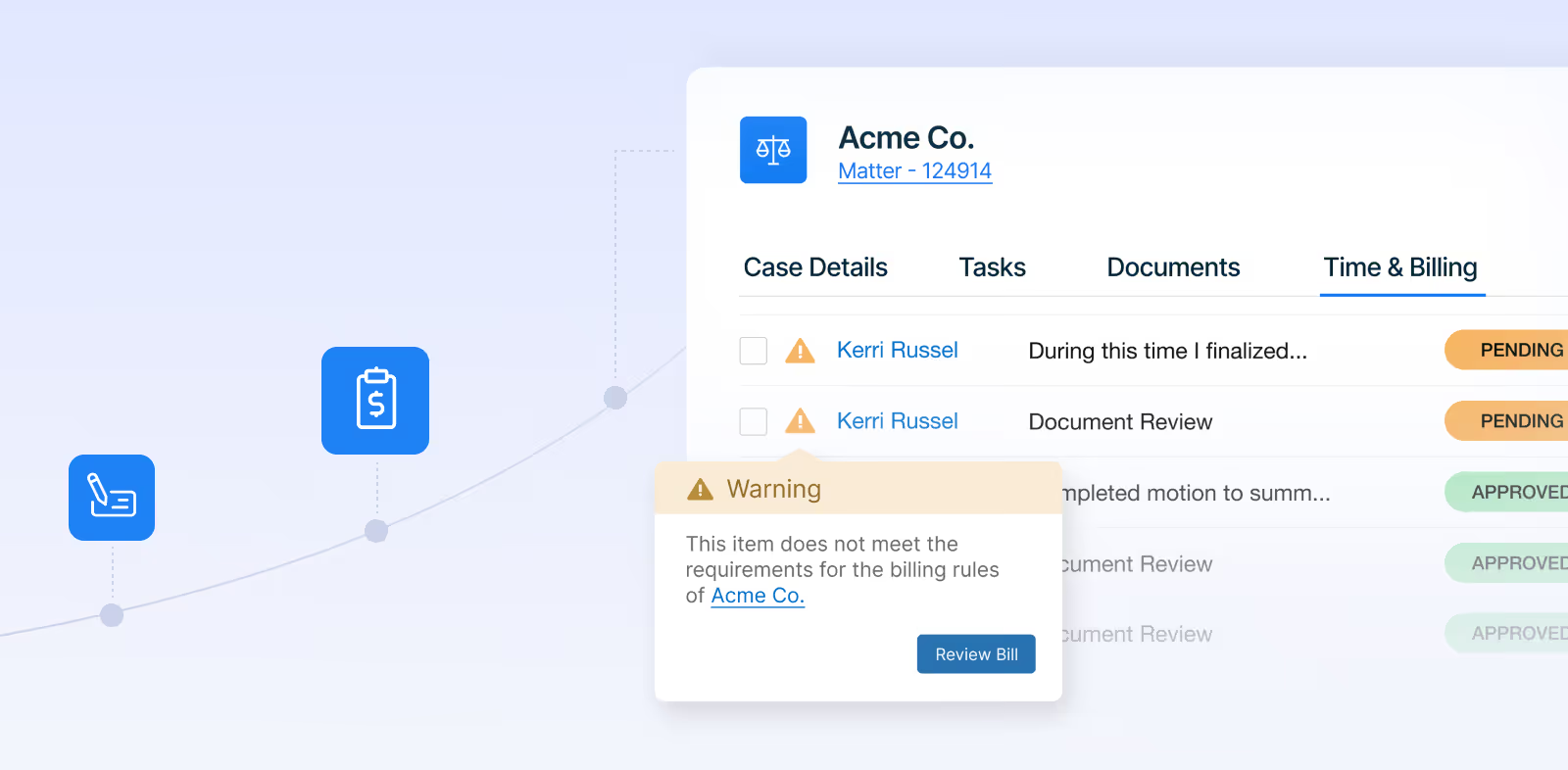
Adhering to client billing guidelines can significantly impact profitability. Carriers reject or reduce invoices that don’t align with approved tasks or LEDES codes. A single error, like coding research time incorrectly or billing multiple timekeepers for a single meeting, can trigger a denial.
Built-in compliance tools within legal time and billing software now flag these issues before an invoice is ever sent.
Handling multi-payer and high-volume cases efficiently
Multi-payer cases add even more complexity for insurance defense firms. When costs must be divided among several insurers or claimants, even a minor error can slow down reconciliation and create confusion across teams.
Modern high-volume billing solutions automate this work. They split fees based on preset rules, update multiple matters simultaneously, and maintain consistency behind the scenes.
With the right tools, billing becomes a steady part of operations rather than a hindrance to efficiency.
Advancements transforming insurance defense with modern software
The shift to cloud-based time and billing software has completely changed how firms manage their work. These platforms now link every part of the process, from approvals to analytics.
Litify is one such platform that connects every part of the billing process. From budgeting and tracking to analysis and eBilling, it clarifies where time goes (and how to make it count).
Embracing automation and eBilling for streamlined workflows
Automation is reshaping the way defense firms manage billing. Tasks such as time entry, rate validation, and approvals occur automatically. That’s hours of manual work saved each week.
Integrated eBilling keeps the process moving by sending invoices straight to carriers and tracking payments without extra steps.
Leveraging AI and analytics for better profitability
If automation handles the work, AI can show what that work means for your bottom line.
AI tools surface trends that show where firms gain or lose value. Predictive insights can reveal which tasks are often reduced or denied, empowering teams to make smarter adjustments before submission.
Over time, those insights turn everyday data into a roadmap for stronger profitability.
The future of insurance defense billing
Billing in insurance defense is headed toward a more intelligent future. Firms will be able to rely on technology that takes care of routine work and turns data into insight they can act on.
AI will help identify trends and flag potential reductions. Platforms of action, like Litify, can also help firms create a permanent record of billing activity, making audits faster. Both firms and carriers could see exactly what was billed, when it was billed, and by whom. At the same time, cloud-based platforms will keep teams aligned regardless of where they work.
The next phase of innovation is about making every decision more informed.
Modernize your insurance defense billing with Litify
Litify gives insurance defense firms a level of control that older systems can’t. Everything from budget tracking to approvals happens in one place.
Configurable workflows and real-time analytics enable defense teams to prevent write-downs and expedite payment cycles, ultimately enhancing operational efficiency. They also make it easier to strengthen relationships with carriers through accurate, on-time billing.
Unlike outdated legacy systems, which were often disorganized, Litify provides a streamlined and efficient process, helping insurance defense firms to execute their time and billing processes precisely, in the correct sequence, and with optimal outcomes.
See how it all comes together. Request a demo today to explore Litify’s insurance defense legal billing solution.
FAQs
What is the evolution of time and billing software for insurance defense firms?
Early time and billing software could only handle hourly billing and basic invoices. As insurance defense work became increasingly complex, firms required tools that could effectively manage multiple payers, flat fees, and LEDES codes.
Today’s platforms are cloud-based, automated, and designed to help firms stay compliant while leveraging data to enhance performance.
How do LEDES and UTBMS improve billing compliance?
LEDES (Legal Electronic Data Exchange Standard) and UTBMS (Uniform Task-Based Management System) bring structure to legal billing. They use standardized task and expense codes, so every time an entry is made, it follows the same format, regardless of the firm or carrier.
How does Litify streamline billing for defense law firms?
With Litify, the entire billing process happens in one place. Time entries are reviewed immediately, where the system checks for missing codes or rate mismatches. Invoices that pass review are sent directly through eBilling, reducing the need for back-and-forth communication with carriers and speeding up payment processing.
What’s next in legal billing technology?
The next wave of legal billing technology will center on intelligence and insight. AI will help forecast trends and identify risks before they become issues, while automation will ensure accurate billing in real-time. These advancements will help insurance defense firms stay proactive.