What Insurance Defense Firms Need to Know About Legal AI Right Now


New data from Litify’s 2025 State of AI in Legal Report reveals that firms are starting to move from AI experimentation to operational adoption, with AI impacting everything from investment priorities to business strategy. But there is still progress to be made in connecting individual efficiency gains with business-wide transformation.
For insurance defense practices in particular, where efficiency, accuracy, and client satisfaction directly impact the bottom line, these findings showcase why firms that strategically and widely embrace AI are poised to set themselves apart from those that hesitate.
While our complete report shares survey results from across the wider legal industry, below, we’re highlighting findings specifically from full service and insurance defense firms. Read on to uncover the most important trends shaping the next phase of legal AI innovation.
Technology budgets are rising
Nearly two-thirds of full service legal organizations saw technology budgets rise this year, clear evidence that AI investment is now a competitive necessity, not a discretionary initiative.
But more important than the amount spent is the intent behind it:
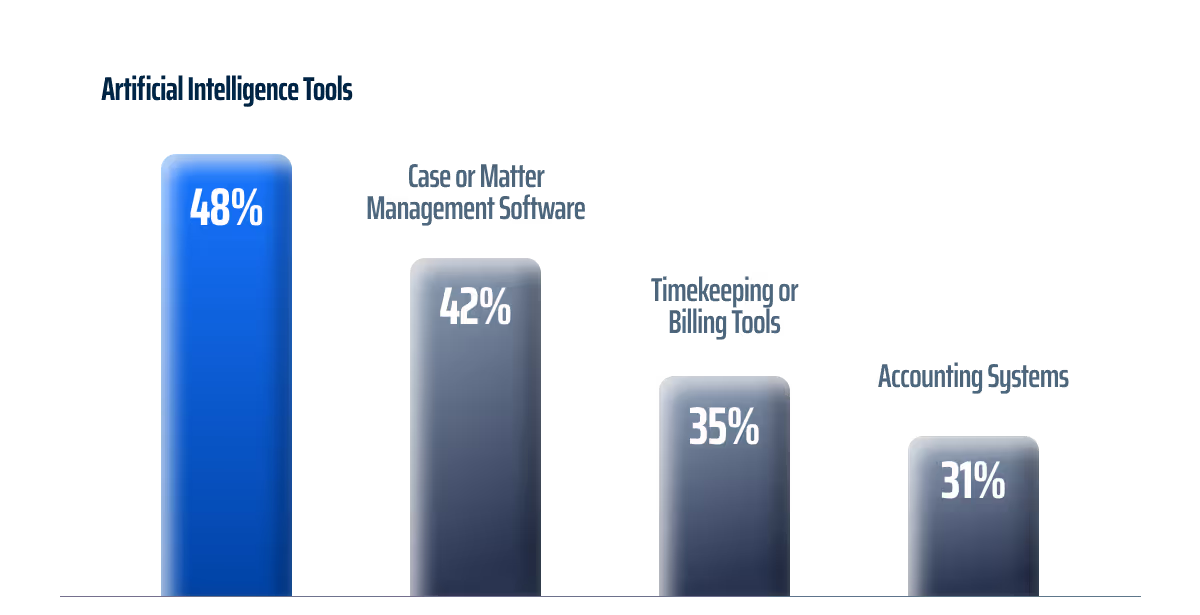
This prioritization signals that firms view AI not as a standalone tool, but as a layer within a unified platform. AI is most powerful when it has access to your firm’s historical data and daily workflows, and can transform a firm’s legal operations even further when investments are also made in AI strategy and training.
Firms are using AI for larger parts of the legal workflow
The data shows that firms aren’t limiting AI to administrative work. Instead, they’re integrating it into larger parts of the legal process.
Current top use cases for full service include:
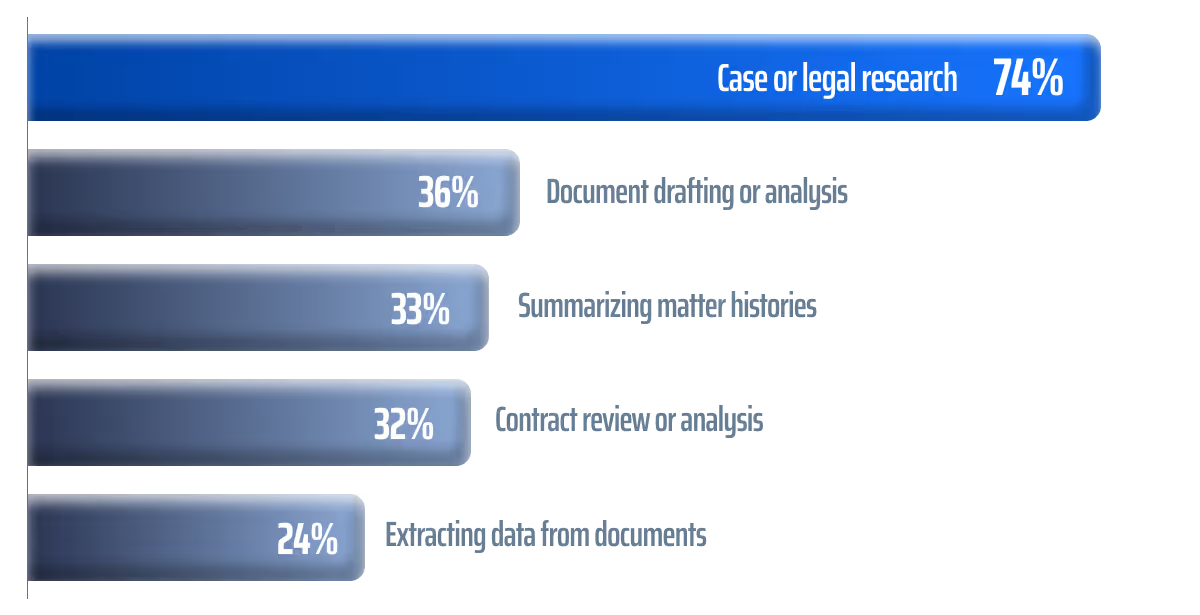
As firms expand their use, more sophisticated uses will start to emerge, such as forecasting missing time entries, reconciling billing rules, and identifying missing records.
Additionally, 77% of respondents now say AI is essential to doing their best legal work. In insurance defense, where accurate case valuation, billing, and reporting are crucial, AI’s ability to surface deeper insights can transform a firm from a one-time vendor into a strategic partner.
The biggest benefit of AI isn’t just speed, it’s increased insight
While AI is often associated with speeding up time-consuming tasks, our report shows its greatest value also lies in information access and decision quality.
Respondents cited the top benefits as:
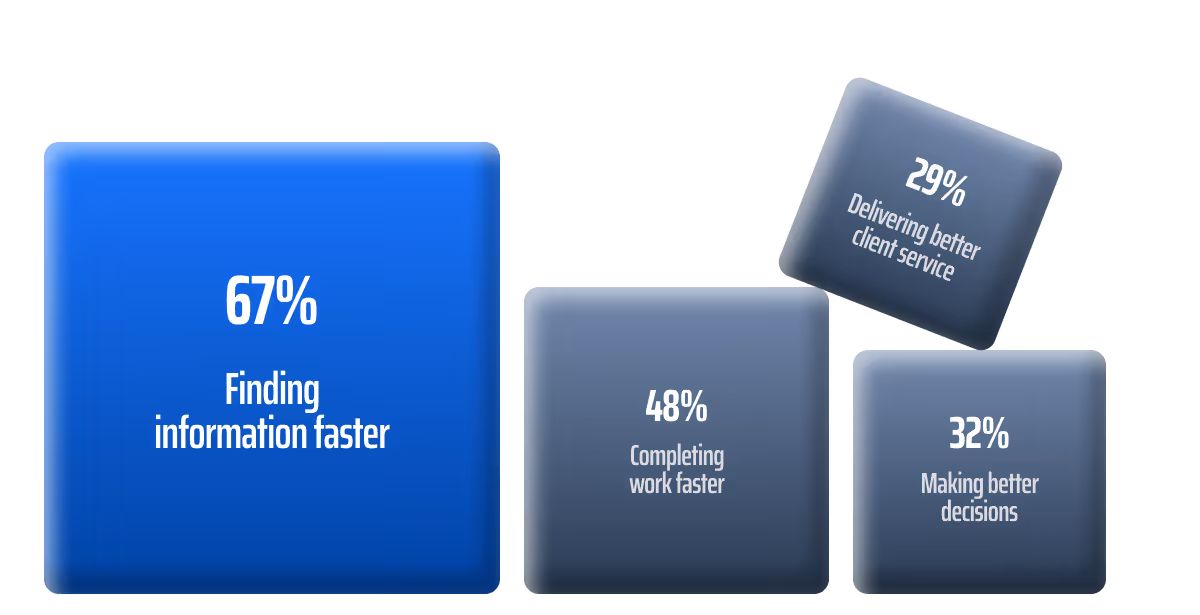
Faster research is helpful, but better decisions can be transformative. AI’s ability to surface relevant information quickly can have a big impact on outcomes for insurance defense firms focused on case assessments and delivering timely insights.
However, our report shows that these individual productivity gains have not yet translated into firm-wide impacts. Now is the time to establish organizational AI adoption goals and begin measuring outputs more comprehensively to move closer to full AI transformation.
Confidence in AI is high, but concerns are still top of mind
Despite AI enthusiasm, 59% of full service professionals cite accuracy and the risk of hallucinations as their primary concerns. This highlights a crucial reality: AI is only as reliable as the environment in which it operates.
Sustainable AI success requires:
- Strict governance: 50%+ of firms now have formal AI policies.
- Clean data: AI needs a single source of truth to remain accurate and valuable.
- Ongoing training: 33% of firms still cite a lack of training as a barrier to ROI.
The ROI of AI
With any new technology comes the question of ROI. For insurance defense firms, our report shows they are seeing value in AI, but with room to grow.
55% of respondents confirm that AI tools are worth their cost, while 2% disagree. However, 36% are still in the "wait and see" camp. This suggests that while the tools provide immediate value in research and drafting, firms are still seeking deeper integration into their end-to-end workflows to fully realize the ROI.
Where is legal AI heading?
The report reveals a burgeoning interest in agentic AI — tools that don't just generate based on prompts, but can actually execute tasks. While only 9% are currently using agentic tools, another 26% are eager to adopt them.
Moreover, AI has become a talent magnet. 74% of respondents say it’s important to work for an organization that embraces technology, such as AI. If firms want to hire and retain the best associates in 2026, their tech stack may be their best recruiting tool.
Positioning your firm for success in 2026 and beyond
The firms that thrive over the next two years won’t be those experimenting with freemium tools or point solutions. They will be the ones operating on AI-powered platforms that bridge the gap between case management, billing, and reporting.
For insurance defense, where timing is everything, AI is the lever that can reduce manual work and amplify strategy. The next decade of legal innovation will be shaped by firms that deeply integrate AI, govern it responsibly, and align it with business strategy.
Interested in more AI insights? Check out the full State of AI in Legal Report. Ready to see AI in action? Schedule a personalized demo.