
The State of Legal AI

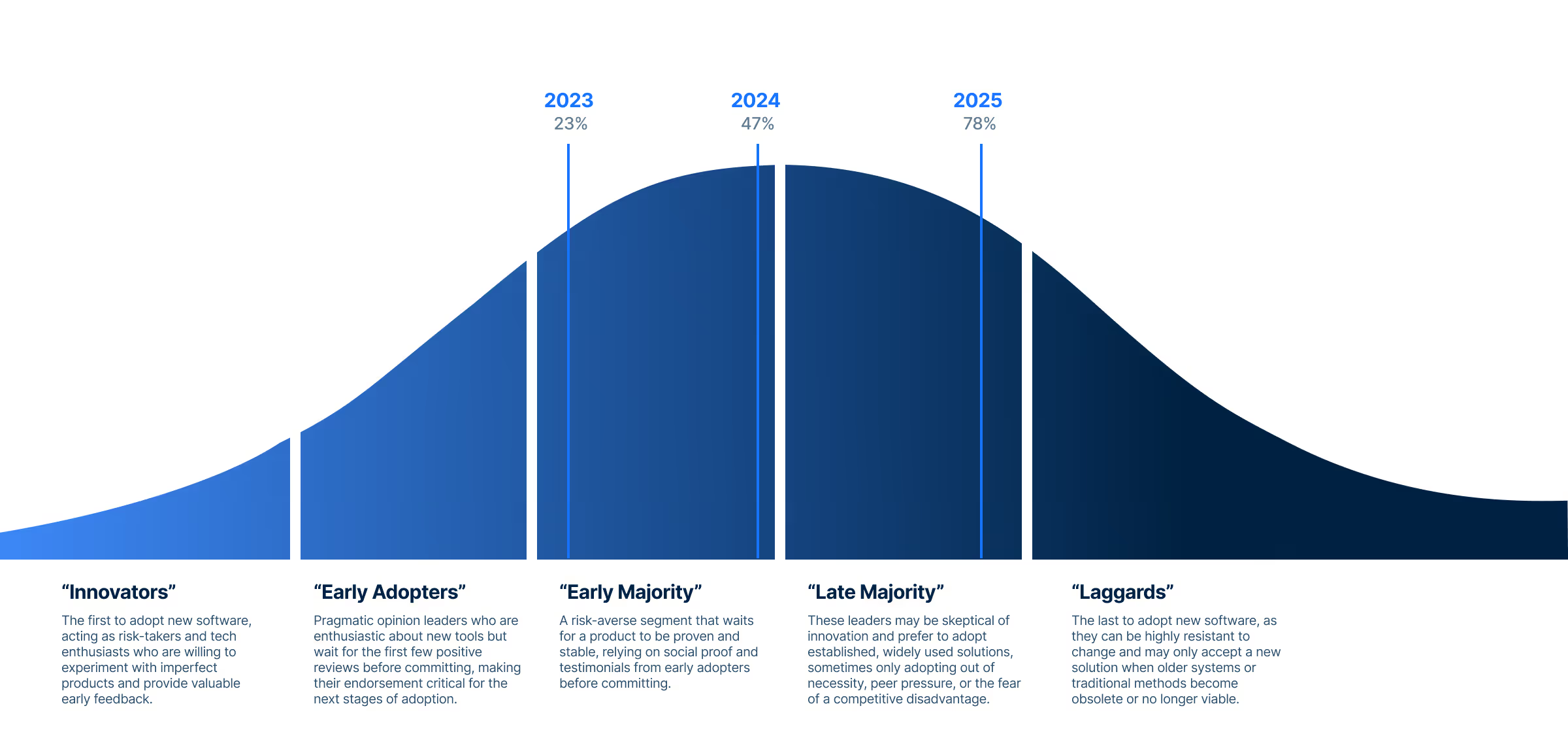
Our latest State of AI in Legal Report reveals that the legal industry is undergoing a more rapid transformation than at any point in the last decade. AI adoption has surged to 78%, a dramatic climb from just 23% in 2023, placing legal firmly in the “late majority” phase of the technology adoption curve.
Yet, despite this remarkable rise, our research reveals a widening gap between the use of AI and its benefits.
Read on for high-level findings from our research, including why law firms and legal departments must adopt AI at the organizational level now, before more businesses make AI their competitive advantage.
AI adoption is on the rise, but driven mostly by individuals, not organizations
Most legal professionals now use AI on a daily or weekly basis, thanks to the easy accessibility of freemium tools like ChatGPT, Microsoft Copilot, and Google Gemini. These tools are simple, inexpensive, and already embedded in everyday applications, which has fueled broad, rapid adoption. But because they’re not purpose-built for legal, usage is expanding only on the surface level, and not deep within the legal workflow.
Meanwhile, enterprise investment in AI is accelerating. Sixty-seven percent of organizations increased their AI spending this year, and expected purchasing has jumped from just 9% in 2023 to 46% in 2025. But that growing budget isn’t yet translating into a cohesive strategy.
Readiness gaps and security concerns are still a challenge
Employees are eager to work with AI: 70% say they want to work for organizations that embrace modern technology, and 82% of employers now prioritize hiring AI-savvy talent.
But readiness gaps persist. Less than 50% of legal professionals report receiving sufficient AI training, and even fewer work at organizations with established AI policies. Security, confidentiality, and accuracy concerns remain top blockers, cited by more than half of all respondents.
These concerns echo the early days of cloud adoption and serve as a reminder that technology alone isn’t enough. Clear policies, training programs, and trusted platforms will be essential to unlock broader organizational use.
AI is still being used for foundational, search-driven work
Today, AI is primarily used for providing quick answers and handling document-centric tasks. The most common use case is legal research, followed by summarizing case or matter histories, document drafting and review, and contract work.
The use of AI for more advanced tasks is emerging, but it remains in its early stages. Workflows such as medical chronologies, responding to legal service requests, and conflict checks are beginning to gain traction, but only with roughly 20% of respondents.
The use of agentic AI — tools capable of completing multi-step actions independently — is also still in its early stages. Only a small minority currently use AI to auto-assign cases, create invoices, handle phone-based client communication, or appeal invoices.
AI is delivering individual productivity, but not yet business ROI
On a personal level, legal professionals report clear benefits. The majority of respondents say that AI helps them find information faster or get work done faster, and roughly a third say it improves client service or overall work quality.
At the business level, however, the impact is far more limited. Only 24% say AI reduces costs, and even fewer report that it increases capacity or billable time.
This gap reflects a critical truth: individual, ad-hoc AI usage won’t deliver the enterprise-level ROI leaders are now expecting. With budgets rising, the era of “try it and see” is coming to an end. Organizations need clear objectives, metrics, and workflow-integrated tools, not just standalone assistants.
From adoption to transformation
The data is clear: the legal industry is no longer deciding whether to adopt AI — it already has. The question now is how teams can unlock the full value of AI.
Most legal teams are seeing strong individual success but limited organizational maturity. Moving forward will require turning individual wins into enterprise adoption, strengthening training programs, creating organization-wide policies, deeply integrating AI with existing legal workflows, and tracking ROI to measure progress.
Over the next 12-18 months, operational and financial leaders will expect AI to significantly reduce costs, increase capacity, accelerate revenue growth, enhance client service, and strengthen competitive differentiation. Teams that invest in the right platforms, training, and measurement now will see the earliest and strongest returns.
Unleash your full potential with Litify
As the industry’s leading platform of action, Litify combines purpose-built legal AI with enterprise-grade technology, end-to-end workflows, and deep business analytics.
Litify’s platform enables legal teams to apply AI securely and consistently across their data, processes, and operations, unlocking business-level value and not just individual gains.
If you’re ready to move from exploration to transformation, Litify can help you get there.
Download the full 2025 State of AI in Legal Report and request a demo of Litify's AI-native platform.