Beyond Adoption: Introducing the Litify Legal AI Maturity Scale


The conversation around AI in the legal industry has shifted. A few years ago, the question was simply, "Are you using it?" But now, with adoption reaching new highs — our 2025 State of AI in Legal Report revealed 78% of legal professionals are using AI — many are realizing that individual productivity gains aren’t moving the needle for organizations looking to maximize AI’s impact.
There’s a big difference between an associate using a free AI tool to summarize a deposition and an organization that has incorporated AI into the full legal workflow. To help close the gap between employee-level productivity and business-wide transformation, we’re introducing the Litify AI Maturity Scale.
The Litify AI Maturity Scale
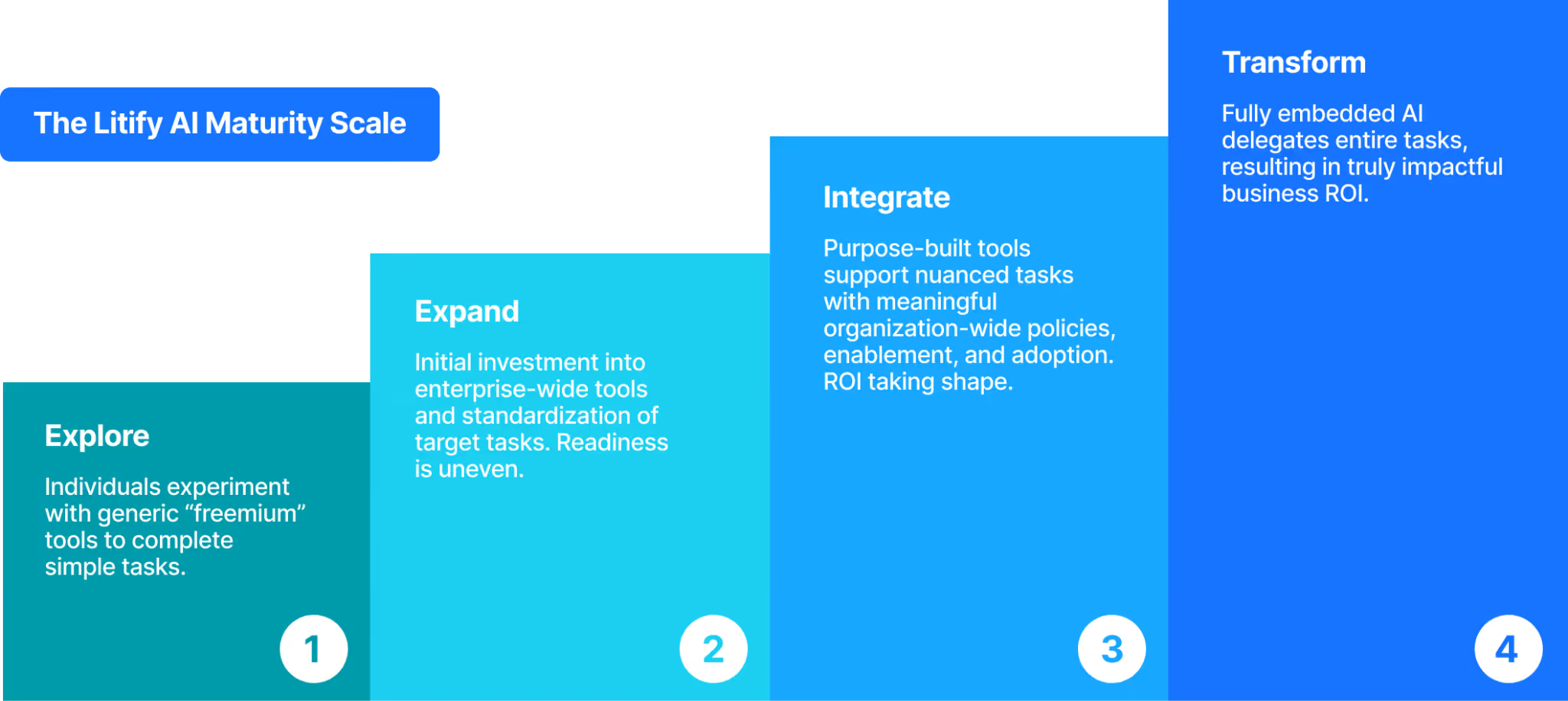
The Litify AI Maturity Scale is a framework to help legal leaders move beyond fragmented, individual-driven AI adoption toward a more robust integration of AI throughout the entire legal workflow. By evaluating growth across four critical variables — legal tools and investment, firm readiness, task scope, and overall impact — firms can use the Maturity Scale to better understand what growth looks like at each phase and what it takes to reach true AI transformation.
To progress, teams need to do more than just buy an AI tool. They must fully integrate AI into their operations, establish training and governance programs, and shift AI use from simple search-based tasks to the delegation of complex, multi-step processes.
1. Explore
In this phase, adoption is largely driven by curiosity. Employees use generic, free tools for simple tasks like summarizing a document or drafting a letter. While attorneys or case managers feel more productive, the firm sees no measurable change or improvement in business outcomes.
2. Expand
Here, the organization takes the wheel. Leadership begins by allocating a budget for enterprise-wide tools and by rolling out foundational data privacy policies. Employees use AI to assist with repetitive tasks, but many still may not feel fully prepared to use something new, so its use remains largely dependent on individual preference. The organization may see certain metrics improve, but team readiness remains uneven.
3. Integrate
This is where the magic starts. The firm moves away from generic tools and invests in AI tailored to specific legal workflows or nuanced, multi-step tasks. Robust policies, training, and enablement programs are created. Leading organizational metrics show clear improvement, but financial ROI has not yet been proven.
4. Transform
At the peak of the scale, AI is fully embedded. Teams are moving toward leveraging agentic AI, in which autonomous tools handle entire workflows with limited human involvement. At this stage, AI is a line item in the budget alongside headcount, and the organization sees meaningful results, such as faster revenue growth and improved margins.
How to progress up the AI Maturity Scale
Climbing the AI maturity ladder doesn't happen by accident. If you find your organization stuck in one of the early phases, here is how to level up:
Shift from generic to legal-specific: Generic AI point solutions lack the full context of your matters, intake processes, and historical case data. To reach the next phase, you need a platform that puts AI directly into the legal workflow, using data within your legal platform as the source of truth.
Solve for readiness early: Legaltech alone won't drive organizational transformation. Our report found that less than 50% of legal professionals have sufficient training or clear AI policies. Without these, organizations may face limitations in progressing to more robust AI use cases, and employees may continue using disparate tools on their own without proper guidance or oversight. High-maturity organizations treat AI education as a core tenet of onboarding, not a one-time meeting.
Focus on task delegation, not just search: If your team only uses AI to find answers quickly, it will be challenging to move beyond the exploration phase. Start by identifying the repetitive, multi-step processes that are creating unnecessary burden, such as intake triage or document generation. Then, look for agentic tools or AI-driven workflows that can own the task from start to finish so the team can focus on more complex projects.
Unleash your full AI potential with Litify
The goal of AI isn't just to work faster; it’s to free your team from highly manual and repetitive tasks so they can focus on why they got into law in the first place: helping clients. As the legal industry’s leading platform of action, Litify is uniquely positioned to guide you through every stage of the AI Maturity Scale by providing purpose-built legal solutions, AI woven throughout the legal process, and a partnership to help teams drive user engagement and adoption.
Ready to see where your organization stands? Download the complete 2025 State of AI in Legal Report to dive deeper into the data and learn more about the AI Maturity Scale. And see where Litify fits — request a demo today.