Buying Legal AI: 13 Questions To Ask

Every legal AI demo feels a bit like a magic show right now. A vendor clicks a button, and suddenly a complex medical chronology, a high-quality legal memo, or a flawless demand draft appears on the screen. It can be easy to get caught up in the excitement, but there’s a big difference between a flashy demo and AI that actually moves the needle for your team.
When the hype clears, your primary goal should be to find a solution that actively reclaims your time and scales your business strategy. To do that, you have to look under the hood.
On your next call with an AI vendor, use these five categories to stress-test the software and separate the noise from reality. This will help establish a baseline and ensure the tool fits into your existing workflows, solves real friction points, and keeps your data secure.
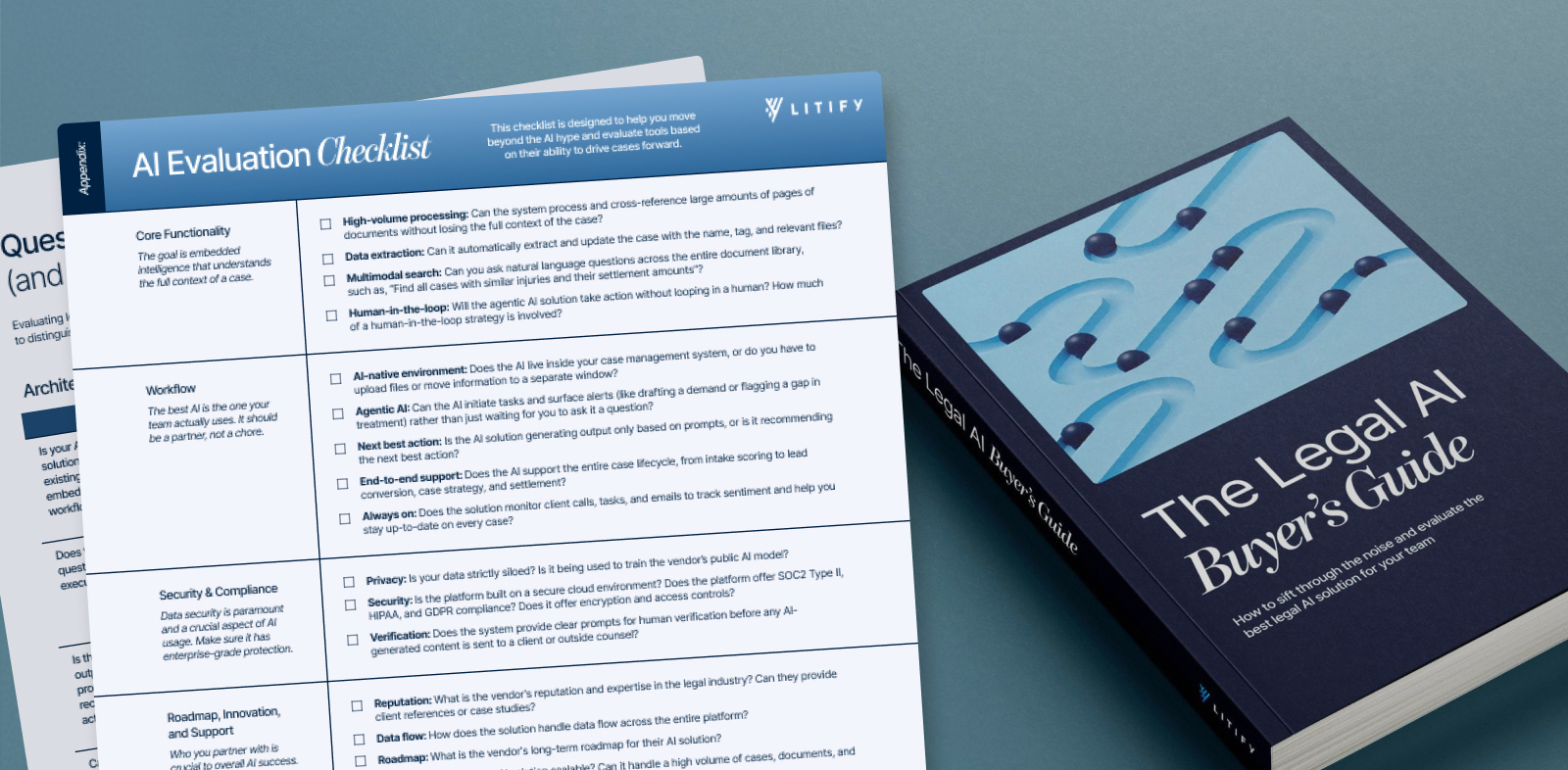
Ready to take your AI evaluation up a notch? Check out the full Legal AI Buyer’s Guide.
Architecture and functionality
An AI tool is only as good as its placement in your tech stack. If your team has to constantly toggle between applications, copy-paste sensitive information, or manually upload PDFs into a separate window, the software isn't saving time — it’s just creating a new, disjointed process. True AI success relies on deep platform integration where your data and processes already live.
Start by asking...
- Is your AI a standalone add-on that sits outside our existing systems, or is it embedded directly into our workflow?
- Does the AI just answer questions, or can it actually execute tasks in our current systems?
- How much of a human-in-the-loop strategy is involved?
Business alignment and expertise
General-purpose AI models understand language, but they don't understand the nuances of the legal practice. A generic AI wrapper adapted for legal use won’t have the context needed to understand industry-specific data, leading to poor adoption and incomplete insights.
Start by asking...
- What is your reputation and expertise in the legal industry?
- How does your AI solution handle data flow across the entire platform?
Cost, ROI, and scalability
AI should be a distinct part of your balance sheet, not an unpredictable expense. To justify the investment, you need a clear line of sight for when the tool will deliver measurable value and how that value scales as your case volume or headcount grows.
Start by asking...
- Is the pricing model per user, per case, per document, or a flat fee?
- What is the expected time to value, and how is ROI tracked after implementation?
Data security and compliance
Legal data is uniquely sensitive. If a vendor uses your confidential case files, medical records, or strategic notes to train a public AI model, you’re facing a massive compliance risk. Enterprise-grade security isn't a premium add-on — it's a foundational requirement.
Start by asking...
- What are the security measures in place?
- Does this solution comply with security standards like SOC 2, HIPAA, or GDPR?
- Does our data leave the platform?
Roadmap, innovation, and support
The legal AI landscape is changing every day. Rather than simply buying a tool for what it can do today, you’re partnering with a vendor for what the tool has the potential to do tomorrow.
If your provider isn't constantly releasing updates or offering dedicated, immediate support when an urgent issue arises, you will quickly find your team left behind.
Start by asking...
- What is your long-term roadmap for the AI solution?
- What is the implementation process like, and how do you handle ongoing support?
- Can the AI solution handle a high volume of cases, documents, and users as our firm grows?
Don't go into your next vendor meeting empty-handed. Download the complete Legal AI Buyer’s Guide to unlock the full evaluation checklist, 20+ deep-dive questions, and a roadmap for finding success in the first 60 days.