The Prompt Is Not the Product: Why Litify’s Approach to AI Is Different

When Anthropic began open-sourcing prompt templates, it quickly became one of the most talked-about developments in AI. For legal technology leaders, in particular, the significance went far beyond the headlines.
The move reinforced a truth the market is rapidly coming to terms with: an AI prompt alone is not a product.
As generative AI becomes more widely understood, legal buyers are asking more sophisticated questions. What exactly creates value? Where does differentiation truly live? And how does AI move from novelty to measurable impact?
The Model Was Always Doing the Work
The uncomfortable truth for point solutions is that the underlying model — Claude, GPT, Gemini — is doing the overwhelming majority of the cognitive heavy lifting. A litigation drafting tool, a contract review add-on, a deposition summarizer: strip out the wrapper, and you’re looking at a foundation model that is guided by instructions.
As that becomes common knowledge, the conversation shifts. If differentiation primarily lives inside a system prompt, it becomes harder to justify long-term strategic investment. Legal leaders are right to look beyond surface-level functionality and ask what they’re really building their operations on.
Partnership Over Wrapping
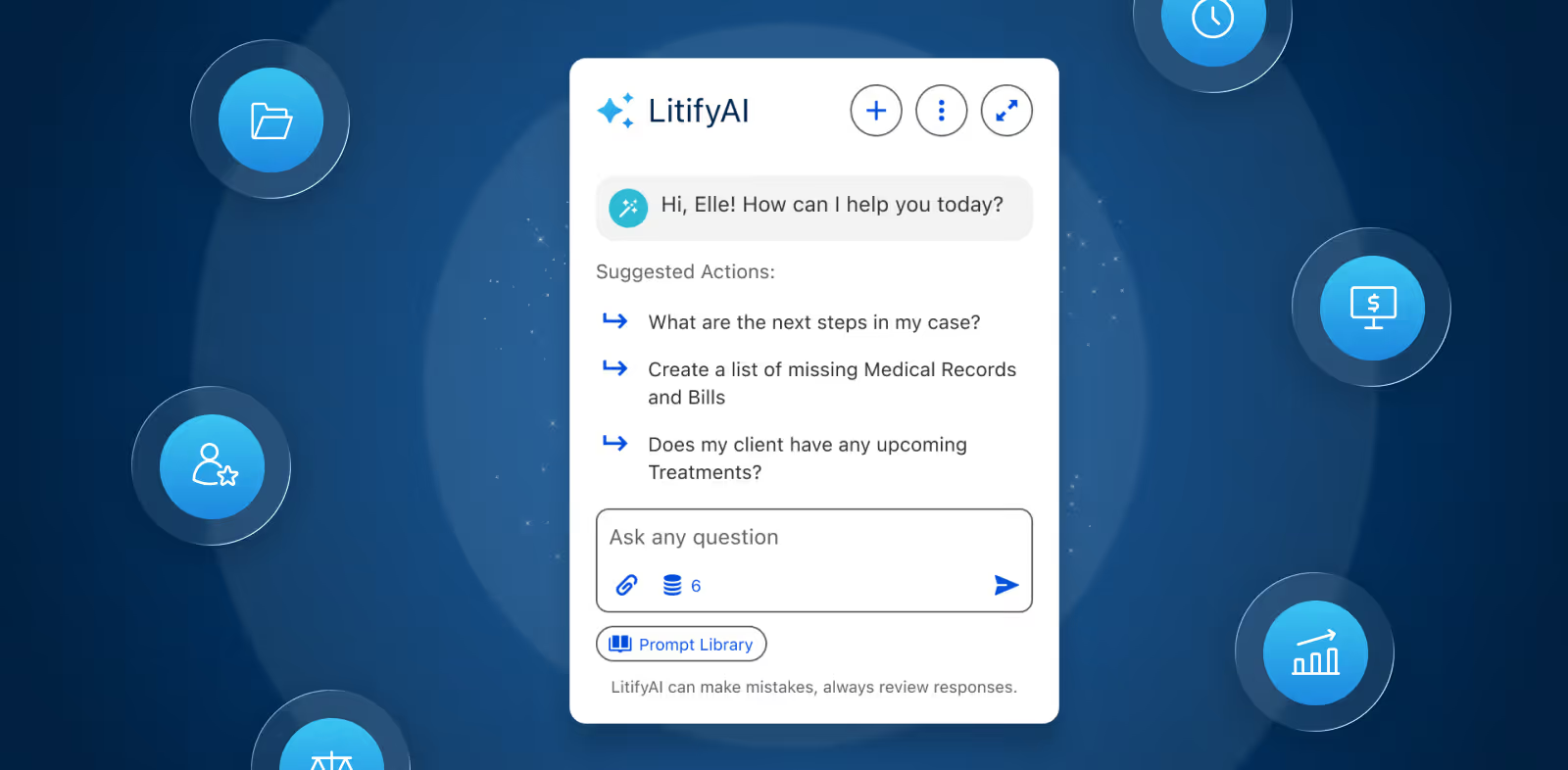
Litify’s approach to AI has always been different. We don’t bolt AI onto the side of a workflow and call it transformation. We partner with Anthropic to integrate Claude into Litify, a platform that legal teams already rely on every day. Not as an isolated tool. Not as a one-off experiment. But as embedded intelligence that is woven into the matters, tasks, documents, and timelines that define a legal professional’s day.
At their core, the skills Anthropic released are still just prompts. To be truly valuable, they cannot exist in isolation. A prompt is only as smart as the information you give it and the actions it takes, which often happen in a separate LLM window. But when that same prompt lives inside your platform of action, it has access to the case data and historical context, which is how the real transformation happens.
Coming soon, Claude’s legal prompts will be available in LitifyAI, providing predefined skills that legal teams can leverage without having to navigate separate tools. Workflows like contract reviews, NDA triage, and risk assessment will be easily accessible right in Litify, taking into account the full context of clients’ case data and documents. The outputs then create building blocks for further workflow automation, such as triggering calendar events or updating reports and dashboards.
That integration depth is what separates a feature from a platform. When AI understands the context of a matter — the client, the history, the deadlines — it stops being a tool you go to and becomes a capability that comes to you. That’s only possible when the model partnership is deep, not decorative.
The End of “Training Your Own Model”
There was a time when “training our own legal model” was positioned as the ultimate competitive advantage. It implied exclusivity and specialization. But maintaining a standalone model is resource-intensive and perpetually outpaced by frontier models that receive billion-dollar investments every quarter while typically training their models on customer data.
Today, the smartest legal organizations are recognizing a more practical truth: you don’t need to own the model. You need to own the workflow, the data strategy, and the relationship with a model provider you can trust. Anthropic’s commitment to safety and enterprise reliability makes Claude a partner worth building on — not a commodity to replicate. Our customers get the power of two world-class technology teams supporting their innovation and AI adoption.
The teams winning with AI aren’t the ones that tried to build everything themselves. They’re the ones who partner with vendors, like Litify, who have chosen the right foundation and built something real on top of it.
Learn more about Litify’s approach to legal AI
About the Author
Andrew Heffernan is the VP of Engineering at Litify. He's a seasoned engineering leader with a diverse work experience in the technology industry who enjoys growing and maturing engineering teams. Prior to Litity, Andrew worked at Validity Inc. where he helped design, develop and manage multiple products on both AWS and Salesforce platforms. Andrew holds a B.S. degree in Information Technology from the University of Massachusetts and a JAVA Development Certificate from the same institution.