AI Use Cases in Law: From eDiscovery to Predictive Analytics

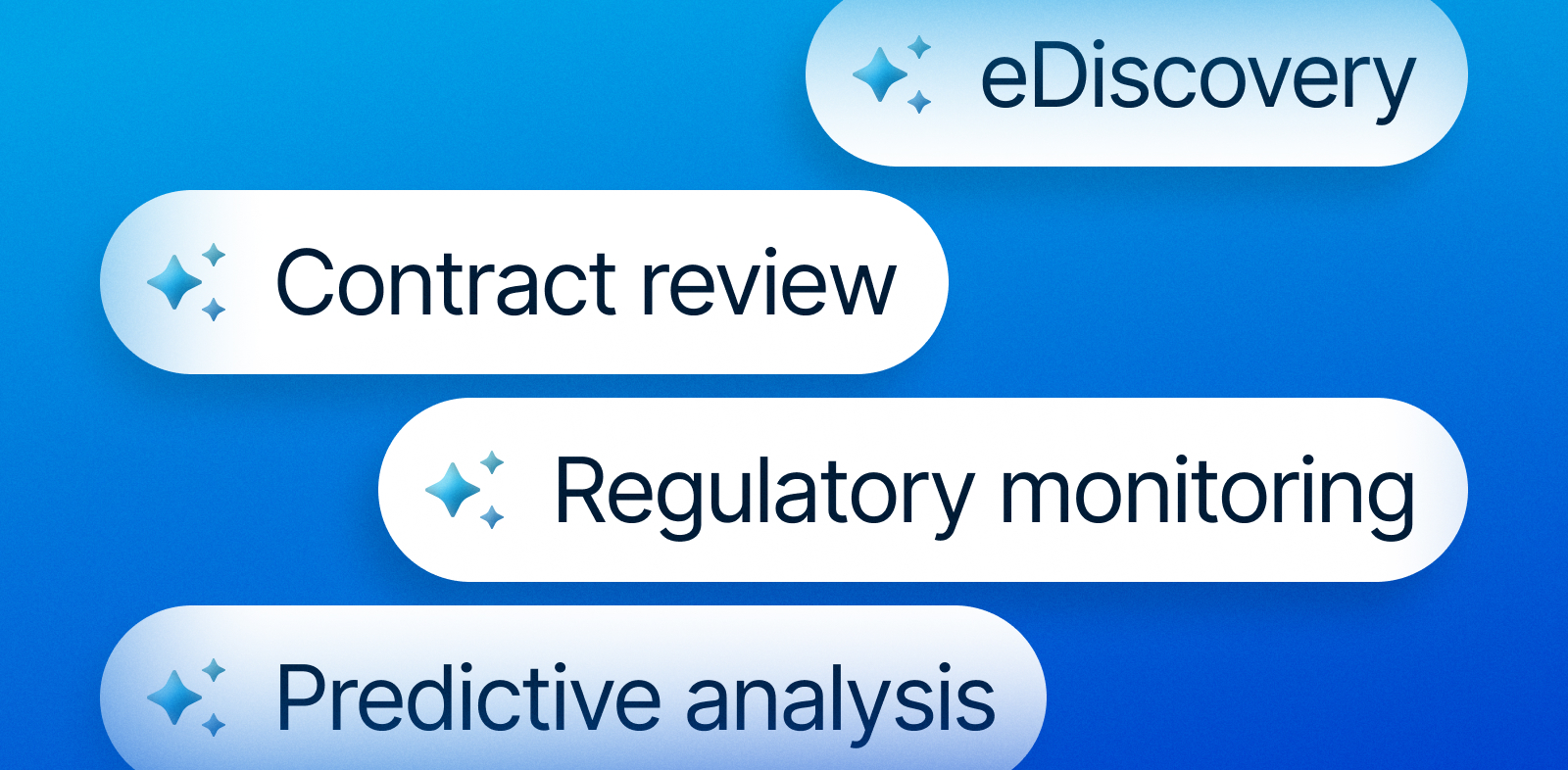
AI use cases in law now stretch well beyond document review. Modern law firms and legal departments are using AI for eDiscovery, contract analysis, regulatory monitoring, and predictive analytics. The catch is that AI only performs at scale when it sits within a unified legal platform of action, with the governance, security, and workflow controls that firms already trust. Litify leverages the power of the Salesforce platform to bring matter management, automation, and AI into a single solution for professionals across the legal industry, including personal injury law firms, corporate legal departments, insurance defense firms, and more.
AI use cases in law have shifted from novelty to a core part of the legal operating model in under two years. According to Litify’s latest State of AI in Legal Report, AI adoption has jumped from 23% in 2023 to 78% in 2025.
The progression is real, but uneven. Most legal teams have adopted AI in pockets rather than as platforms. A research tool here, a contract reviewer there, a redlining assistant for one practice group. This article explores the AI use cases that matter most to law firms and legal departments, including litigation support, compliance, and governance.
What are the top AI use cases in law today?
The top AI use cases in law today fall into five categories: litigation support, corporate legal and compliance, the practice of law, legal operations, and governance.
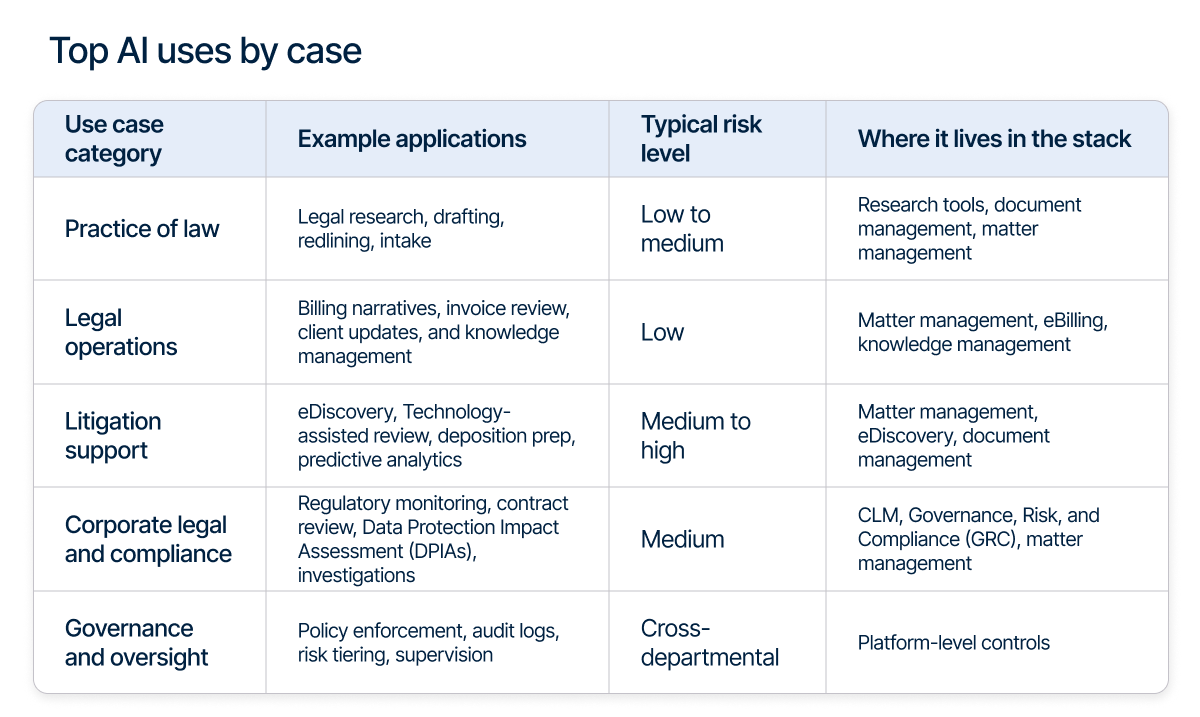
What holds many teams back is not the technology. It is the fragmentation underneath it. AI cannot route matters intelligently when intake lives in a shared inbox. It cannot surface precedents if the precedents are scattered across drives. In practice, AI readiness is data readiness.
The regulatory landscape is also catching up. The ABA issued Formal Opinion 512 in July 2024, defining lawyers' ethical obligations regarding generative AI under the Model Rules governing competence, confidentiality, communication, candor, and supervision. The EU AI Act introduced risk-tiered obligations for high-risk AI systems used in legal and judicial contexts. The NIST AI Risk Management Framework provides legal teams with a vendor-neutral framework for governing AI throughout its lifecycle.
AI use cases in litigation
How does AI improve eDiscovery and technology-assisted review?
AI improves eDiscovery by prioritizing responsive, privileged, and hot documents at scale. Technology-assisted review, or TAR, uses machine learning to rank documents by relevance based on attorney coding decisions on a smaller seed set. Volumes that once took months of linear review can be processed in days with documented defensibility, which is why TAR remains one of the most established AI use cases in law firms today.
The defensibility piece matters more than the speed. Courts expect validation, sampling protocols, and a clear record of how TAR decisions were made. The Sedona Conference TAR Case Law Primer remains the foundational reference. Best practice is human-in-the-loop review for privileged and hot documents, with batched AI review for clear-cut responsiveness calls.
AI for case chronology, fact mining, and deposition prep
AI builds defensible chronologies from email, chat, contracts, and prior filings, then surfaces inconsistencies across testimony, productions, and pleadings. The output is a working timeline that updates as new documents come in.
For deposition prep, AI generates issue maps, candidate lines of questioning, and impeachment angles tied to specific exhibits. The most useful question it answers is often the simplest: what changed between draft A and draft B, or between deposition testimony and the contemporaneous email record.
Predictive analytics for litigation outcomes
Predictive analytics models historical case data to estimate motion likelihoods, settlement ranges, and case timelines. Used well, it informs strategy decks with probability ranges rather than false certainty. Used poorly, models trained on historical outcomes encode historical bias. Communicate ranges, not point estimates, and document the data used to train the model.
AI use cases in corporate legal and compliance work
How does AI support regulatory monitoring and compliance reviews?
AI supports regulatory monitoring by tracking rule changes across topics, geography, and product line, then translating those changes into obligations, owners, deadlines, and evidence artifacts. A new privacy regulation becomes a tracked obligation with assigned reviewers, deadlines, and audit-ready documentation.
The same approach applies to investigations. AI accelerates triage, scopes communications review, and flags drift between written policy and day-to-day practice. The signals were always there. The question is whether the platform is acting on them or storing them.
AI for privacy, data protection, and records management
AI assists data protection impact assessments and privacy impact assessments by generating first-draft analyses against templates, mapping data flows across systems, and flagging cross-border transfer and vendor risk. Record management benefits from AI-assisted classification and retention tagging, particularly at enterprise scale, where manual classification has been impractical for years.
Contract review, risk analysis, and due diligence
AI flags missing clauses, nonstandard language, risky obligations, and renewal traps against a firm's playbook. Generic high-, medium-, and low-risk labels are less useful than risk scores tied to organizational tolerance. A liability cap acceptable to a software vendor may be unacceptable to a clinical trial sponsor. For due diligence, AI accelerates document review and creates an audit trail showing who reviewed what and when, a record that is often more valuable than the speed gain itself.
AI use cases in the practice of law: Research, drafting, and intake
Where do AI copilots actually help with legal research?
AI copilots help with legal research by clustering relevant authorities, spotting issues, and checking for negative treatment, all with citations and jurisdiction filters. The non-negotiable feature is source traceability. Every cite should link to the underlying authority, and the tool should refuse to fabricate citations. Workflows differ: in-house counsel often need scanning across regulations, advisory memos, and contracts, while firm associates need depth in a narrower domain with stronger validation.
Drafting, redlining, and document automation
AI generates first-pass memos, briefs, motions, and client letters when paired with firm playbooks, clause libraries, and style guides. The output should look like the firm's work product, not the model's default voice. Redline suggestions become useful when they mirror the firm's standard positions and acceptable fallbacks. Long-document summarization is most valuable when the output is a usable work product rather than just an executive summary.
For more on this AI use case, see AI for legal drafting.
AI for matter intake, conflicts, and triage
AI standardizes intake by extracting parties, dates, venues, deal size, and risk flags from intake forms, emails, and source documents. Matters then route to the right practice group through configurable rules and machine learning, with early screening that leaders trust enough to act on. Litify supports agentic AI workflows that take action across intake, triage, and routing rather than just recording the data.
AI use cases that improve legal operations and margins
Timekeeping, billing narratives, and invoice review
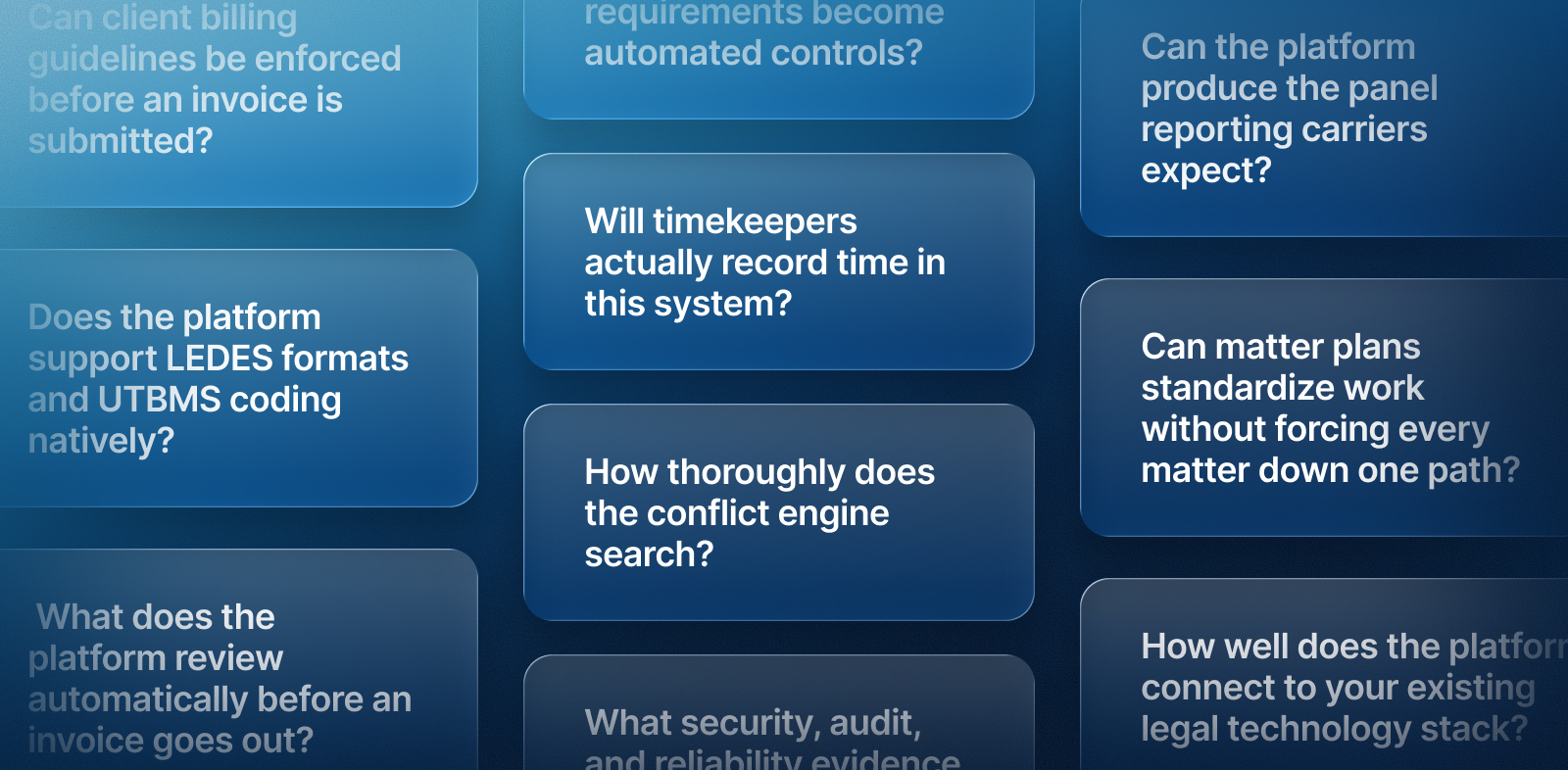
AI generates compliant billing narratives from activity logs without padding, flags outside counsel guideline violations before invoices go out, automatically tracks time, and reduces write-offs. The discipline is to use AI to enforce guidelines, not to manufacture entries. Pair it with legal workflow automation so the billing layer connects to the matter, the timekeeper, and the outside counsel guidelines.
Client communications and service delivery
AI produces clearer matter status updates and proactive issue alerts. The most useful update is rarely "here is the activity log." It is "here is what changed since the last update, and here is the decision needed this week."
Knowledge management and precedent systems
AI turns past matters into reusable playbooks, templates, and clause banks. Search starts by understanding "what did we do last time?" across matters and jurisdictions, and precedents stay current instead of decaying in a knowledge base that no one updates.
Approved AI use cases in large law firms: Governance and risk tiers
How do firms tier AI work by risk?
Large firms approve AI use cases by tiering work based on confidentiality, complexity, and downstream legal consequences. Putting a firm-wide policy in place, embedded in the platform attorneys already use, takes the burden off individual lawyers to enforce rules matter by matter.
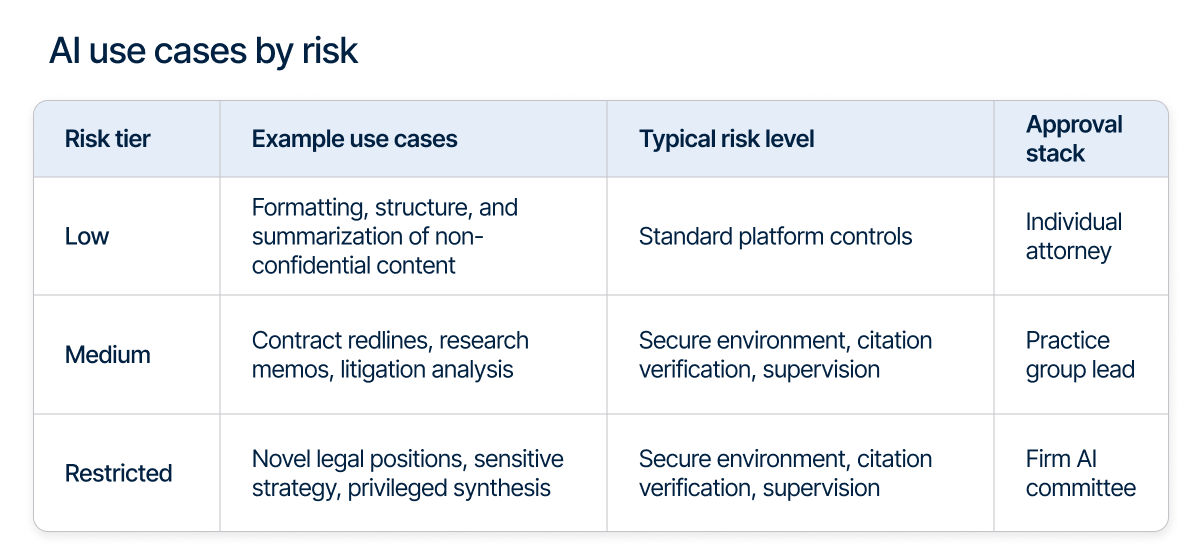
Vendor diligence belongs at the platform level. Confirm data retention terms, whether inputs are used for model training, breach response timelines, and certifications against frameworks like the NIST AI RMF and ISO/IEC 42001. The ABA reports that 43% of firms now prioritize integration with trusted software when evaluating legal AI. Approved AI use cases in large law firms live inside platforms that already meet firm security and supervision standards.
How do legal teams measure ROI from AI without incentivizing bad legal work?
ROI from AI is measured on three dimensions: cycle time, quality, and adoption. Cycle-time metrics include contract turnaround, discovery review velocity, and research time. Quality metrics include error rates, rework, and client satisfaction. Adoption metrics reflect real usage by matter type, not vanity license counts. The trap is incentivizing speed at the expense of judgment. Tie AI metrics to outcome quality first, throughput second.
How to evaluate AI tools for your legal team
What to look for in a legal AI platform
The strongest legal AI platforms share four characteristics:
- Security and data protection. Single sign-on, role-based permissions, encryption at rest and in transit, audit logs, and clear breach response.
- Ethical and regulatory fit. Emphasizing human-in-the-loop oversight ensures AI enhances, rather than replaces, attorney judgment. This includes hallucination controls, citation requirements, and alignment with industry best practices and frameworks.
- Matter awareness. AI that respects matter boundaries and prevents cross-matter leakage by design.
- Workflow integration. AI embedded where the work already happens, configurable rather than rigid.
Looking for more guidance on evaluating AI platforms? Check out our complete AI Buyer’s Guide.
Assess your legal team's AI readiness
AI readiness is more about data and process than technology. Start with three checks:
- Data readiness asks where matters live, how clean the metadata is, and whether content is searchable.
- Process readiness asks which workflows are standardized enough to automate.
- People readiness asks who the champions are, who the reviewers are, and whether the team has a safe-to-learn training culture.
Start with pilot matters that fit AI
High-volume, low-risk matter types make the best starting points. Good candidates include:
- NDA review and redline against a firm playbook
- Intake triage and routing for high-volume practice groups
- Document summarization for non-privileged discovery sets
- Billing narrative generation against outside counsel guidelines
- Regulatory change tracking for a defined topic or jurisdiction
Pick matter types with clear before-and-after baselines, and define success criteria that partners and GCs will accept up front.
Common AI mistakes lawyers using AI should avoid
The pattern of AI mistakes is consistent across firms and in-house teams:
- Relying on general-purpose AI for legal work product without supervision
- Treating AI outputs as accurate without verification
- Pasting confidential data into unsecured tools
- Operating without firmwide policies, training, and enablement
Each mistake gets easier to prevent when AI lives inside the platform the team already uses, governed by the policies the firm already enforces.
Turn AI from novelty into an operating model with Litify
AI is only as powerful as the platform beneath it. While scattered standalone solutions create siloed data, process bottlenecks, and security risks, Litify brings AI directly into the core workflows your team uses every day.
Litify leverages the power of the Salesforce platform to unify matter management, intake, document automation, and AI within a single ecosystem. We help leading law firms, corporate legal departments, and insurance defense teams move past isolated AI experiments and into scalable AI-powered workflows to ultimately drive higher margins.
See how Litify helps modern legal teams unleash their full potential.
Key takeaways
- AI use cases in law now span litigation, corporate legal, compliance, the practice of law, and operations, with eDiscovery, contract review, regulatory monitoring, and predictive analytics leading the highest-impact list. AI use cases in law span the entire matter lifecycle, including litigation, corporate legal, compliance, the practice of law, and operations. Document review is only the starting point.
- AI adoption in U.S. private practice tripled from 11% to 30% in a single year and hit 46% among firms with 100 or more attorneys. The highest-impact applications include eDiscovery, contract review, regulatory monitoring, and predictive analytics, all of which benefit from structured data already living in a legal operations platform.
- Firm-wide AI policies embedded in the platform legal teams already use carry the weight of ethical compliance, so the risk tiering, supervision, and confidentiality controls required under Approved AI use cases in large law firms depend on risk tiering, supervision, and confidentiality controls aligned with ABA Formal Opinion 512 and the NIST AI Risk Management Framework get enforced by default rather than matter by matter.
- Firm-wide and team-wide AI policies reduce individual ethical exposure. When AI is embedded in the platform that law firms and legal teams already use, there is a solid foundation for security and compliance, rather than relying on each attorney to enforce the guidelines on their own.
- Litify leverages the power of the Salesforce platform to unify matter management, workflows, data, automation, and AI in one place, enabling legal teams to adopt AI responsibly and at scale.
Frequently asked questions about AI use cases in law
What is technology-assisted review (TAR)?
Technology-assisted review uses machine learning to rank documents by relevance to a legal issue, based on attorney coding decisions on a seed set. It is widely accepted in US federal courts and defensible when paired with validation and sampling protocols.
What is GRC?
GRC stands for Governance, Risk, and Compliance. It refers to the organizational function and the software category that manages enterprise policy, risk registers, regulatory obligations, and control evidence. In legal contexts, GRC systems typically sit adjacent to matter management: the GRC platform tracks obligations and controls at the enterprise level, while the matter management system runs the legal work those controls generate.
What is the difference between generative AI and predictive AI in legal work?
Generative AI creates new content, such as drafts, summaries, and redlines. Predictive AI estimates likelihoods based on historical data, such as motion outcomes, settlement ranges, and case timelines. Most modern legal AI platforms use both.
What are the most common AI use cases in law today?
The most common AI use cases in law today are eDiscovery and TAR, contract review and redlining, legal research, drafting and summarization, regulatory monitoring, matter intake and triage, and billing narrative generation.
Can AI replace lawyers?
No. AI accelerates specific tasks within legal work, but professional judgment, client counsel, advocacy, and supervision remain attorney responsibilities. ABA Formal Opinion 512 makes clear that lawyers retain accountability for AI-assisted output.
What AI use cases are typically approved in large law firms?
Large firms typically approve AI for low-risk work, such as formatting, summarizing non-confidential content, and standard contract redlines against firm playbooks. Medium-risk work, like research memos and litigation analysis, requires secure environments and supervision. Restricted work involving novel legal positions or sensitive strategy requires partner sign-off and walled AI environments.
How does AI support eDiscovery without compromising defensibility?
AI supports defensible eDiscovery through documented validation protocols, sampling, and human review of privileged and hot documents. The defensibility record matters as much as the speed gain.
How accurate is predictive analytics for case outcomes?
Predictive analytics is most accurate as a probability range rather than a point prediction. Accuracy depends on data quality, model design, and the comparability of historical matters. Treat outputs as inputs to strategy, not conclusions.
Will AI replace paralegals and legal operations roles?
No. AI changes the shape of the work for paralegals and legal operations roles, but does not replace them. Roles shift toward supervision, configuration, exception handling, and client communication.
How does AI use align with the EU AI Act, ABA Opinion 512, and NIST AI RMF?
The EU AI Act sets risk-tiered obligations for AI systems, including high-risk uses in legal and judicial contexts. ABA Formal Opinion 512 defines US lawyers' ethical obligations around generative AI under existing Model Rules. The NIST AI Risk Management Framework provides a vendor-neutral lifecycle approach to AI governance. Together, they form the practical baseline for an organization’s legal AI policy.