The Legal Marketing Blueprint: 10 Ways to Grow Your Pipeline


The legal marketing landscape is undergoing a major shift. The days of a predictable, linear consumer journey are officially over. Today, prospective clients have shorter attention spans and spend their time scrolling through social feeds, navigating mobile screens, and using AI search engines to find immediate answers.
To build a highly predictable growth engine, today’s law firms must view marketing and intake as one single, interconnected pipeline. Here are the 10 strategic insights to help transform your firm's data into bottom-line business performance.
#1: Focus marketing spend on measurable digital engines
Investing heavily in marketing without the ability to track its direct impact can leave more questions than answers. Firms must shift their focus away from unmeasured marketing channels toward platforms that offer meaningful data loops and outcome signals. If firms can’t precisely measure where a case originated, the marketing budget is better spent elsewhere.
Transitioning from a focus on unmeasured media to measurable digital channels can help firms increase caseloads while unlocking deeper insights about marketing performance. This shift relies entirely on a willingness to lean into digital channels and advertising algorithms rather than fighting them.
The biggest hurdle for legal marketers here is resisting the urge to make impulsive adjustments. Digital advertising is inundated with daily noise. To succeed, firms must look past the immediate noise, avoid panic-driven reactions, and make decisions based on long-term macro patterns.
Consider this real-world example of a personal injury firm that optimized an automated Google PMax campaign over a 12-month timeline:
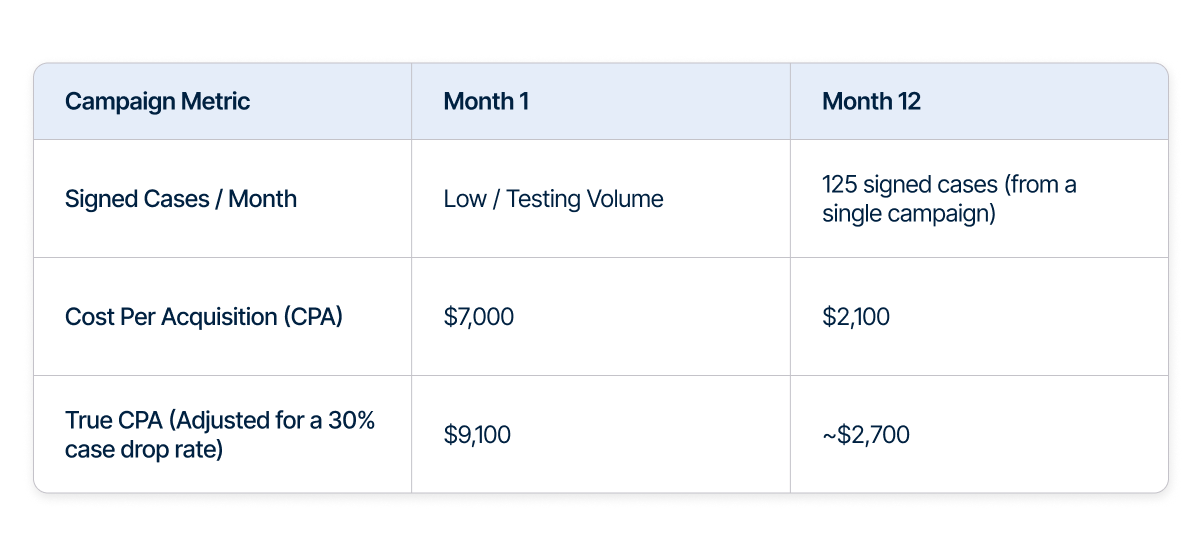
When this campaign first launched, the firm was surprised by the high initial case acquisition cost, which rose even higher after accounting for historical case drop rates.
But instead of pulling the plug, the firm iterated. They fed the platform clean, structured data, assigned real case values to create a continuous feedback loop, and tightened their negative keyword targeting. By month 12, the campaign was generating 125 cases a month at a more sustainable cost.
The takeaway is clear: iteration beats perfection. Automated ad tools cannot simply be implemented and then forgotten. They must be continuously trained with rich data from your case management platform to successfully lower acquisition costs over time.
#2: Optimize digital content for AI
Search engine optimization has become less about preparing content solely for human readers and more about structuring your firm’s digital presence for AI interpreters.
AI search tools and overviews are capturing a massive amount of prime real estate on mobile screens, taking up to 40% of the page. This reduces the space firms have traditionally relied on, meaning fewer spots for paid search, Local Services Ads (LSAs), Google Business Profiles (GBPs), and standard website links.
To ensure your firm remains visible, focus on your underlying data structure:
- Eliminate unstructured data: Leaving critical details, metrics, or outcome signals trapped in unstructured fields or internal notes, rather than in searchable data fields, makes them invisible to search engines.
- Build smarter, clean architecture: Transition to templates built for clearer navigation and faster insights. The goal is to produce smarter content with a clear architecture that allows an AI engine to instantly understand the meaning behind each webpage your firm owns.
#3: Focus on data hygiene (with AI search in mind)
Cleaning up database fields, enforcing strict entry rules, and transitioning away from unstructured data tracking may feel like future goals or operational plans to tackle over several years.
But AI search is not a distant, futuristic concept. The shift is happening now, and firms should start working on getting their database in order. If your internal data is currently messy or unstructured, AI search models may misinterpret it or exclude it from their results.
To survive this shift, firms must transition from loose data practices to strict data discipline. This means ensuring every critical data point is entered into searchable, structured fields rather than left in unstructured notes. Cleaning up your data infrastructure is essential if you want your firm to be visible in the search landscape moving forward.
#4: Move beyond vanity metrics
A massive trap for growing law firms is falling in love with vanity metrics. There is a distinct line between marketing that is purely about show versus marketing that delivers true substance.
When reporting on marketing campaigns, it’s easy to get distracted by top-of-funnel numbers that look impressive but mean very little for your bottom line. To build a predictable marketing engine, firms must learn to separate superficial data from true business growth:
- Recognizing the show: Flashy reports filled with high impression counts, millions of clicks, and cheap, generic web leads are all part of the marketing show. Celebrating a massive spike in raw traffic is meaningless if those clicks are bouncing or yielding low-quality leads that simply clog your phone lines.
- Focusing on the substance: True substance is measured by actual conversions and bottom-line efficiency. It means tracking how many of those leads become qualified prospects, how many contracts are generated, and the exact Cost Per Case.
A campaign that generates hundreds of low-cost leads but only signs a couple of cases is far less valuable than a targeted campaign that generates fewer leads but signs them at a much higher rate. Moving from show to substance means holding every single marketing dollar accountable to actual conversion metrics rather than superficial visibility.
#5: Treat intake as an extension of marketing spend
A common operational pitfall is the willingness to allocate a large budget to a brand-new marketing campaign while not investing enough in the intake specialists who answer the phone.
Your intake department is the voice of your firm. Investing in staff development, quality assurance, and competitive training should be considered marketing spend, rather than just an administrative overhead line item.
When intake specialists are tasked with navigating hundreds of unique clicks or disjointed fields to process a single prospect, data integrity plummets. To ensure clean data from your team, you must first eliminate data-entry fatigue.
Start by replacing chaotic, multi-path intake systems with simplified, linear visual trackers. Simplifying the intake pipeline allows your team to stop fighting with software and focus entirely on qualifying leads and building client relationships.
#6: Eliminate the disconnect between marketing and intake
No matter how much money you spend on high-converting ads, your marketing engine will stall if there is a disconnect between your marketing and intake departments. In many practices, these teams operate in completely isolated silos, which ultimately breaks down the whole system.
To build a seamless handoff, firms must identify and resolve the common friction points that naturally occur on both sides of the operational aisle:
Common marketing friction points:
- Launching campaigns without the "why": Marketers often implement complex tracking systems or roll out new ad channels without explaining the strategy to the intake team. This leaves call center agents unprepared to handle the leads generated by those campaigns.
- Isolating data due to consolidated roles: In many firms, a single leader is forced to run both marketing and intake out of sheer necessity. Because they are stretched thin, they often pull reporting in a vacuum and can’t share real-time campaign insights with either team.
- Prioritizing aesthetics over backend processes: It is easy to focus strictly on creating beautiful, high-budget brand campaigns while ignoring the actual backend process for how prospective clients will be handled once they call your firm.
Common intake friction points:
- Operating disconnected from active messaging: When the intake team answers incoming calls without visibility into the firm's active marketing campaigns, they struggle to align their conversation with the specific promise that prompted the client to call in the first place.
- Over-promising just to get a signature: In an effort to secure a contract, intake processes can sometimes lead to over-promising specific results. This creates an immediate operational challenge for the legal team, who must then walk back those unrealistic expectations once they take over the case.
- Treating the role as simple message-taking: If intake staff view their job as merely answering phones rather than nurturing leads, the firm may face slow response times, long wait times, and a lack of accountability for the marketing campaign that generated those calls.
To eliminate departmental friction, leadership must align marketing and intake into a single, interconnected system. When both departments share clear, open lines of communication, the entire firm wins.
#7: Think of AI as a marketing teammate
Many law firms are still treating AI as a passive piece of software to occasionally use to automate a basic task. To truly win the marketing race, firms must view AI as an active collaborator and teammate.
High-performing firms are embedding AI and business intelligence (BI) into their daily internal operations to supercharge their human staff. Analysts, marketing directors, and operational leaders can use AI to sift through large volumes of firm data, analyze internal databases, and discover patterns because AI is uniquely equipped to identify the specific parameters and data points to look for. When embedded as an internal teammate, AI can make your smartest people even smarter.
#8: Bridge the attribution gap between client memory and true data tracking
When analyzing where your best cases come from, relying purely on what a client remembers can be misleading. There is a fundamental gap between what people think led them to your firm and the actual data path that brought them there.
If an intake agent asks an incoming lead, "How did you hear about us?" a client might say, "I saw your billboard,” completely forgetting that while the billboard made them familiar with your name, they actually typed your firm into Google and clicked a paid search ad.
To build a highly predictable marketing engine, firms must look past what the caller remembers and automatically track the real digital touchpoints. Integrating your digital agency data directly with your core case management platform allows you to build a closed-loop network that accurately attributes the exact campaign that generated the call.
Both pieces of information are valuable, as knowing what your clients remember tells you which brand messages stick in their minds. But when making budgeting decisions, objective tracking data is crucial. Marrying these can help firms confidently trace settlements back to their exact digital origin.
#9: Gain market intelligence from "closed lost" reasons
For even more insight into firm performance, high-performing practices spend just as much time diving into data about why cases were lost or rejected as they do for cases won.
By enforcing mandatory drop-down fields for final case dispositions in your case management platform, firms can capture meaningful operational data. Rather than allowing intake staff to simply type in a vague note like "client didn't sign" or "they hung up," firms must document the exact reason behind the loss:
- Identifying specific competitor loss: Tracking when a qualified lead explicitly chooses another firm. By logging which competitor they chose, your marketing and operations teams can analyze where you are losing market share.
- Spotting changing client intent: Documenting when a prospect walks away simply because they changed their mind and decided they no longer want to pursue the legal claim at all.
A lost lead is a critical piece of business intelligence. When you transform vague rejections into structured, searchable data points, you stop guessing and gain a clear diagnostic map to help address breakdowns between marketing and intake.
#10: Connect marketing costs to case outcomes
To measure your marketing performance even more effectively, you don’t need to juggle separate accounting systems or disconnected spreadsheets. You can close the tracking loop by bringing your monthly marketing spend right into the platform where your case data already lives.
Litify provides built-in capabilities designed to connect your advertising costs with your firm’s legal workflows automatically:
- Centralize monthly spend: Instead of keeping your ad budgets siloed in external software, you can enter your monthly spend for each marketing channel (like Google Ads or television) directly into the platform. This adds the missing financial link to your case tracking.
- Track the full case lifecycle: Litify’s marketing dashboard instantly calculates your performance across the entire pipeline. It builds charts showing exactly how many leads were generated, how many retainer agreements were sent, and how many cases were signed by each source, and automatically calculates cost per lead and cost per retainer.
- Expose blind spots: A dedicated section of the dashboard automatically flags "unattributed leads." These are intakes generated by web forms or external tools that lack a source or marketing spend attribution. Spotting these helps your team clean up data gaps before they impact your reporting.
- Map historical trends: You don't have to start from scratch. If you have older marketing budget sheets, you can mass-upload that historical data in bulk using a spreadsheet template. Litify retroactively updates your reports, instantly visualizing your long-term campaign trends and historical ROI.
Data on daily intakes, retainer statuses, and final attorney fees is already available in Litify. By connecting monthly marketing costs to your other marketing metrics, you instantly unlock clear, reliable data that tells you exactly where to allocate your marketing budget.
Learn how Litify can help your firm take marketing and intake to the next level. Ready to see Litify in action? Schedule a demo today.